
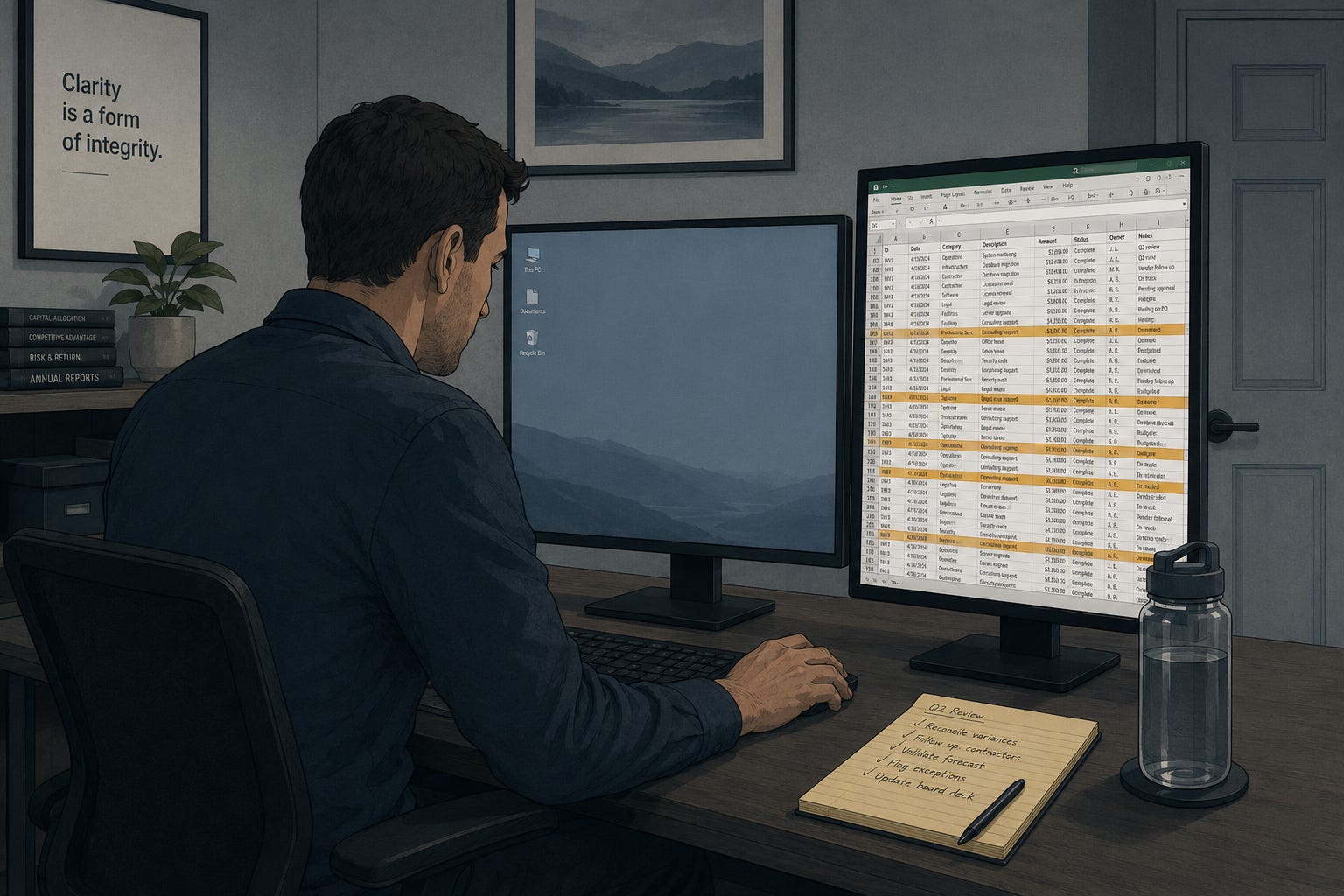
Two or three times a year, an email arrives that takes over my workday.
A faculty member has suspicions about a student’s quiz performance. The language is careful but the meaning is clear: they think the student cheated. They want evidence. They want their Canvas administrator to arm them with the data that confirms what they already believe, so they can walk into the Provost’s office with a bulletpoint argument that says the Canvas admin said so.
After I read through that email, I’ll re-read it. Then I will get up from the desk in my home office, go refill my water bottle, sit down on my living room sofa, and look out the front window to think for a few minutes. Visualize my steps, remind myself what data I will be acquiring in the next hour. I go back upstairs, sit back down in my office chair, and close every open browser tab. Exit every open software application. The rest of my morning’s tasklist moves to the afternoon.
I’m in CSI mode now.
What follows is an hour, sometimes more, of forensic work that most faculty never see and don’t know to imagine. Canvas page view logs exported to Excel. Hundreds, sometimes thousands of rows of student activity data spanning multiple academic courses. Breaking news: students are on Canvas a LOT during an academic term. I filter everything except the teacher’s course, plus or minus one day from the quiz attempt. I sort by time to build a chronological sequence of activity. I highlight the relevant rows, the ones that tell the story of what the data actually shows during the quiz window, because sending an unfiltered spreadsheet to a teacher and asking them to interpret it is a guaranteed way to cause grey matter to spill out of ears.
There’s a lot in those logs beyond a simple click record. IP addresses. User agent strings identifying the browser, the device, the operating system. Whether the student was on a desktop or laptop browser, a mobile phone browser, the dedicated Canvas Student App. Each data point means something specific. Some log entries carry weight I’m not permitted to deploy without authorization.
The IP address is Personally Identifiable Information for someone using Canvas. I don’t reveal it. Not to the teacher, not in an email, not in a live consultation, not even when the teacher makes a compelling argument that university-owned network data isn’t personal information. It is. I hold the line. Quietly, with a smile, because I understand where they’re coming from, but I hold it.
“I understand your disappointment with the lack of information I am providing about your student’s quiz attempt. However, I will be happy to share this information with the Provost’s Office when my upper management approves it. It’s the best I can offer you for these...unique...circumstances.”
Before any finding goes anywhere, I alert my upper management. I document the faculty request, the nature of the allegations, the data I’ve found. I wait for the green light. I am not a lone gunslinger shooting my mouth off about what the logs infer. I require institutional backing before this moves forward, because if this case escalates to an Academic Dishonesty proceeding, I will have to answer for my findings, and I will not be caught having disclosed protected information or overstated what the data actually shows.
Here is what I will never say, in writing or verbally, under any circumstances: the student cheated.
What I will say, with upper management clearance and only with upper management clearance, is this: “The data in Canvas is showing that the student may have accessed the quiz from a location or device not associated with a dedicated university computer lab, as your quiz settings required.”
May have accessed. From a location or device. That language is doing enormous work in a very small number of words. It’s precise. It’s bounded. It delivers the truth the teacher needs without delivering more truth than the evidence permits or the system authorizes. If the teacher pushes for more, I broken-record back to it. “The Canvas data is showing that...” The sentence doesn’t change. The finding doesn’t expand beyond what the data actually supports. No ad-libbing or conversational riffing for this interaction.
Some teachers accept this. Some push back. Some are frustrated that their Canvas administrator won’t simply confirm the accusation and hand them the smoking gun they came for. Again, I understand the frustration. A teacher who suspects a student of dishonesty is carrying something heavy, a betrayal of the academic contract, a student who may have gamed a system the teacher trusted. Their anger is real and it deserves acknowledgment.
But the student on the other side of those log files doesn’t know I exist. They have no idea that someone is triple-checking Excel rows right now, verifying findings before they go anywhere, making sure the timeline is right, the interpretation is sound, and the language is precise. They’re going about their day, unaware that a finding about their quiz attempt is being handled with the same care a surgeon brings to a procedure: methodical, documented, checked, and checked again.
Because here is what I bring into every investigation request: the weight of what a wrong finding costs. The student’s future degree. A job offer waiting on a clean academic record. An entire future running on a trajectory that one incorrect data interpretation could knock sideways permanently.
I never want to be the person responsible for knocking someone’s life asteroid into a different trajectory.
So I triple-check. I get the clearance. I say “may have accessed” instead of “cheated.” I hold the line on PII even when it costs me goodwill in the professional relationship. I take the high road, not because the policy requires it, but because the student at the other end of the data deserves someone in that process who is taking the whole thing seriously.
Being leveled with means getting the truth. The whole truth the evidence supports, delivered as precisely and completely as the situation permits, no more and no less. It means the person across from you isn’t telling you what you want to hear. It means they’re telling you what they can actually stand behind. And sometimes suspicions and gut instincts are shown to be incorrect.
This is the seventh thing every client deserves. It’s the hardest one to give.
More later...