
I am an Enneagram 1. The improver. The optimizer. The person who cannot be in the vicinity of a system not running at its best without having a compulsion to fix it.
This is an excellent trait for a technology consigliere. It is a less welcome trait at home, for my wife’s iPhone. She often has to assure me it is working just fine and does not require reorganization, optimization, or an unsolicited audit. I must confess she’s had to tell me this more than once. My wiring doesn’t always distinguish between a client’s Canvas course and a spouse’s home screen, and it has taken diligent work to unleash the optimizer only when invited.
Fortunately, I’ve had thirty years of invitations from clients to improve their technology.
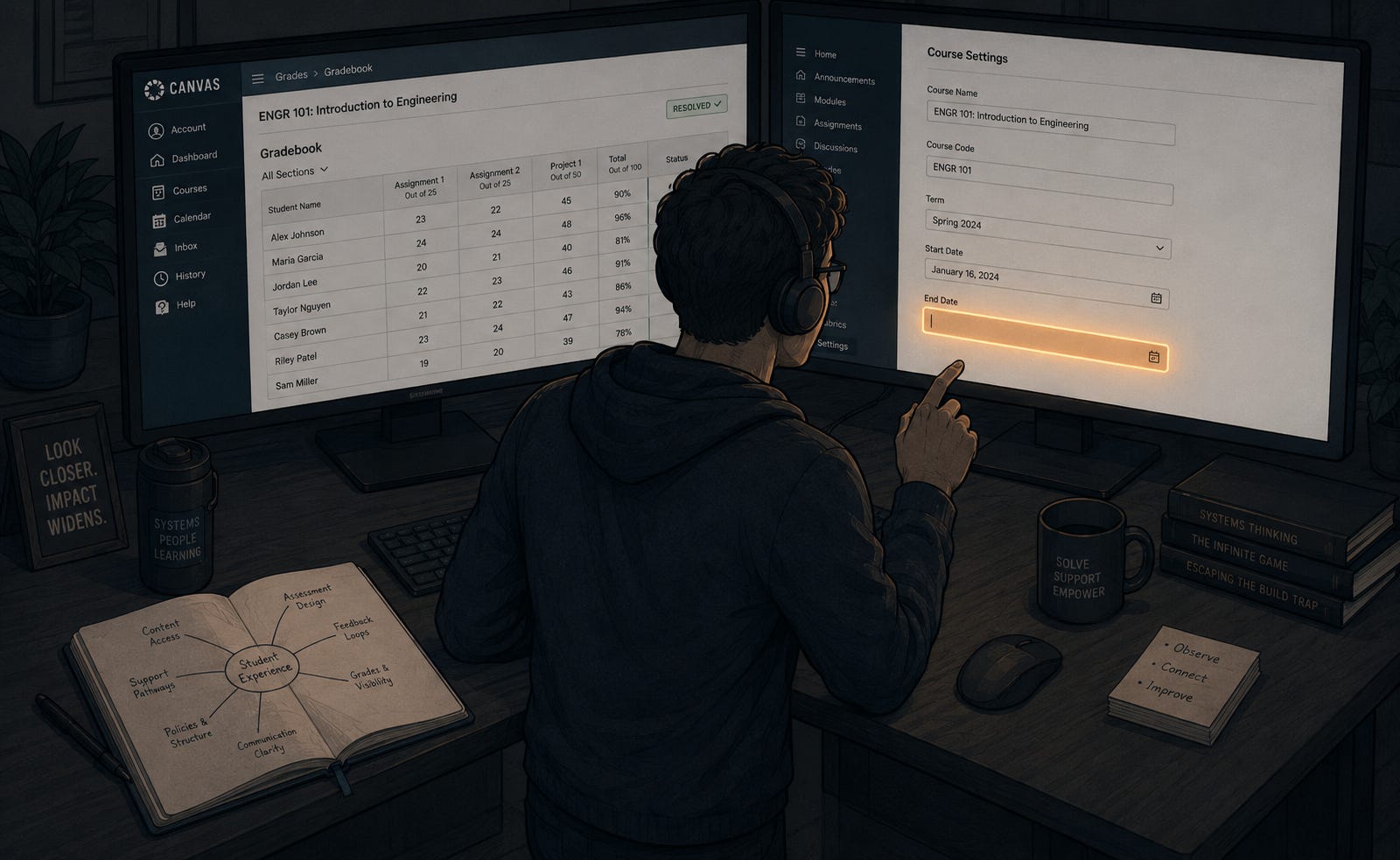
Here’s how my mind works during a support consultation: My client arrives with one issue. A broken gradebook. A missing assignment. A quiz with settings that can’t be set. That issue is the hub. But the moment I’m inside their course, the optimizer in me activates and spokes start radiating outward simultaneously. Assignment group percentages that don’t align with what is stated in the syllabus. A final exam still hidden from students four days before it’s due. A course with a start date but no end date, sitting in students’ dashboards like a ghost that doesn’t know it’s supposed to have moved on.
My client doesn’t see any of this. Their mind is a single line originating from the original problem. Mine is a hub with a dozen spokes, each one representing something that is either wrong now or about to be wrong later.
The easier path is to fix the gradebook, confirm it’s working, close the meeting, and move on. Most technologists take that path. They’re not wrong to take it; the job description doesn’t require noticing the end date. Nobody assigned them that task. The ticket didn’t mention it. Scope is the ticket, and everything outside the ticket is someone else’s problem or the client’s problem to discover on their own later in the term, probably at the worst possible moment, probably while students are emailing them about it.
But once you notice it, you have a choice. I’ve arrived at a place where I know when to deploy the optimizer in me. But it wasn’t always like that.
Early in my career I made the mistake of mentioning everything I noticed the moment I noticed it. The response was rarely gratitude. More often it was the glazed expression of someone whose brain had already reached its technology capacity for the afternoon and was now being handed a second invoice when they’d only budgeted for one. I learned quickly that a client contending with one active problem has exactly zero bandwidth for a second problem, even a future one, even one I can fix in twenty seconds.
So I made a rule for myself. Fix the primary issue first. Everything else gets a mental bookmark.
The consultation proceeds. We work through the original problem together. I keep the bookmarked spokes in peripheral vision but I don’t mention them or let them distract from the single line my client is following. When we arrive at the fix, when the gradebook scores are aligned with the syllabus percentages or the assignment is visible or the quiz is publishing correctly, I ask: “I think we’re lookin’ good now. How are you doing?”
They respond with a relieved or pleased tone. Everything looks good. Thank you so much. I really appreciate your help.
I can hear them mentally wrapping up. And that’s my cue.
“May I make an observation about your course?”
Almost always I’ll get a yes unless they are running late for a meeting. The primary crisis is resolved, they’re relaxed and feeling good. What else you got for me, Mr. Fix-it?
“When we were in the course settings page earlier, I noticed something that might create some unwanted confusion down the road. May I show you what I’m referring to?”
Another yes. I navigate to the course settings and wiggle my mouse around the start date with no corresponding end date.
“I noticed there’s an earlier date set for when students can access the course, which is totally fine. But without an end date, your course won’t auto-conclude at the end of the term. It’ll stay in your students’ dashboards indefinitely.”
I pause a bit to let it sink in, then I continue with the normalization.
“I usually get a handful of emails at the start of each new term from students asking why an old course is still showing up in their dashboard. In every case, once I add the end date from the previous term, the course immediately disappears from all enrolled students’ dashboards. And I never hear about it again.” A small smile here. “Takes about twenty seconds.”
I look up the end-of-term date. I fill it in. Done.
“Now I think we’re doing better than before.”
The response is always positive. Not always effusive, because the client is processing something that didn’t feel like a problem thirty seconds ago and now feels like a near miss. But positive. Grateful. Slightly relieved in a new way.
What I just gave them wasn’t part of the appointment. They didn’t ask for it, nor did they know it wasn’t even a problem. But somewhere in the next few weeks, when that end date quietly does its job and no confused students email their teacher, or me, asking why an old course is haunting their dashboard, a small thing will go right that they’ll never know almost went wrong.
That’s what being protected looks like. It’s observing ways to improve the client’s situation and doing the quiet work to prevent additional stress. It’s having your clients’ best interests in mind. It’s not letting them learn the hard way.
That’s the difference between a help desk and a consigliere. One fixes what’s broken. The other finds what’s about to break before you do.
More later...