
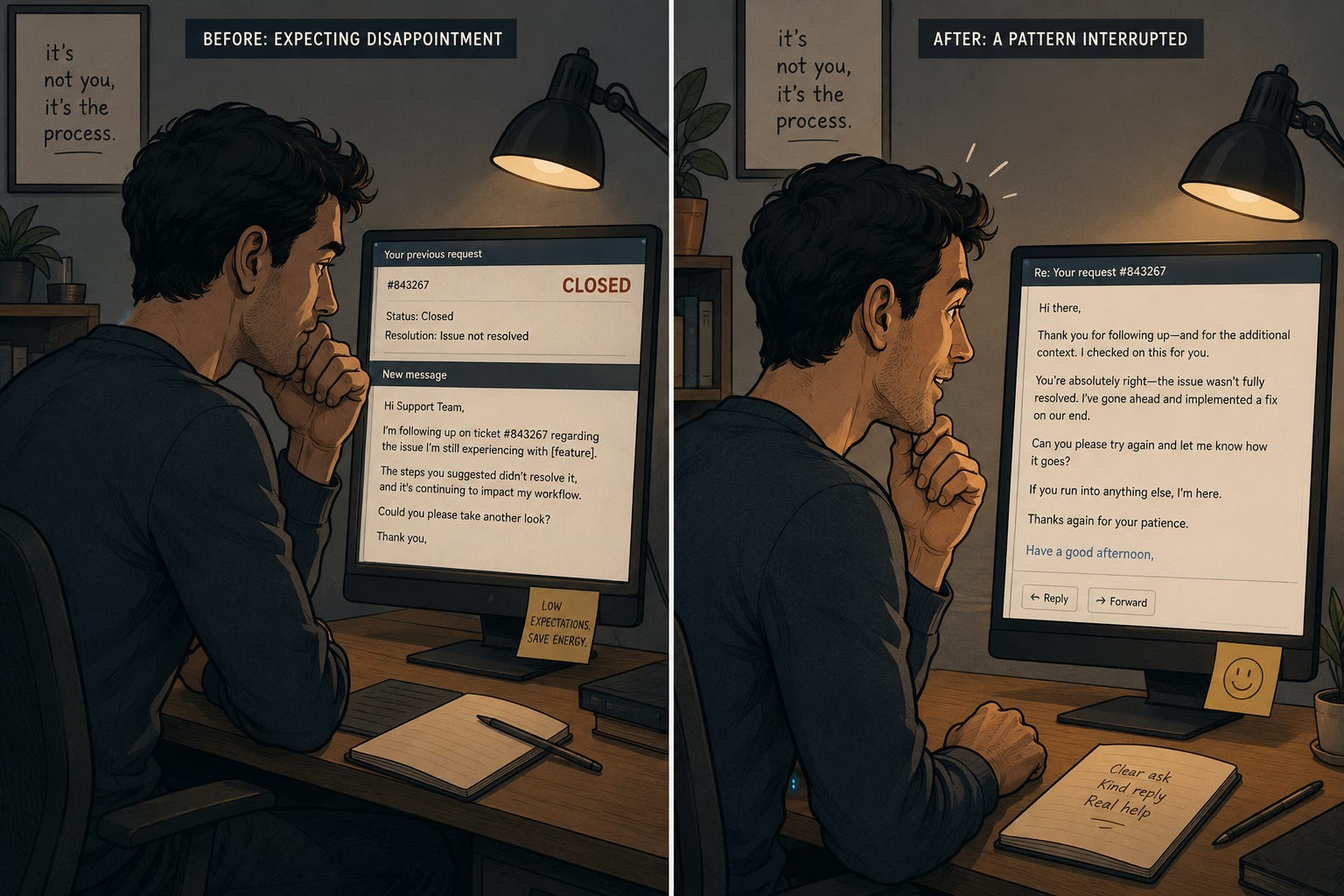
Most people enter into a technology support interaction carrying luggage. Not the good kind with roller wheels and telescoping handles. The kind of luggage acquired from years of being put on hold, of being read to from a script, having their problem recited back verbatim as though parroting the problem was a substitute for resolution, and then having the ticket closed before anything actually worked. This sort of luggage makes a person’s neck muscles tense the moment they have to contact IT for anything.
I understand this part of life intimately. I’ve had many jaw-clenching, teeth-grinding frustrations of dealing with a support person speaking at one volume with the boiler room support much louder in the phone call. I’ve closed my eyes and drooped my head in dismay as the script-reader told me they cared about my problem in exactly the way the training manual told them to care. I immediately pick off the hollow professionalism of someone performing helpfulness without delivering it.
So when a new faculty member sends me their first support request and the tone is guarded, or terse, or sounds like someone bracing for disappointment, I don’t take it personally, I view it as an opportunity. I don’t view them as being disrespectful. I am assuming they are protecting themselves from someone like me, a subject matter expert in an institutional IT role. The poster child for every unsatisfactory experience they’ve ever had with tech support has made a lasting impression.
Their email message can have a condescending explanation or steps they tried that didn’t quite solve the problem to avoid me starting from the eye-rolling, “did you turn it off and on again?” first troubleshooting step.
My response to a wary first communique is the same every time. Good morning. Here’s what happened and here’s what I did about it. Please reach out if anything else comes up with your courses. Have a good afternoon.
Clean. Warm. Resolved in one exchange.
I’m not performing kindness. I’m extending respect before it’s been earned because everyone deserves a clean slate, and I know exactly what it cost them to ask for help in the first place. The first interaction isn’t just about solving the problem. It’s about being the exception that starts rewriting a pattern that someone else built.
Sometimes it works. The exterior crust of frustration gets a crack in it. The next email arrives a little warmer. Eventually the relationship finds its footing and the full relational methodology comes online, the follow-up question, the conversational explanation, the shiny fresh juicy apples in the bag alongside everything they asked for.
But sometimes it doesn’t go this way. Not every guarded client is carrying old luggage. Some of them have established a pattern that has nothing to do with prior bad experiences and everything to do with how they move through institutional hierarchies. I spot the difference quickly. The name in my inbox tells me most of what I need to know before I’ve read a single word.
There’s the faculty member who can’t seem to take me out of a mental compartment labeled “the help.” The professor who peppers their support requests with subtle jabs, prefacing questions with, “You probably don’t know the answer to this” while asking someone with thirty years of immersion in the technology they’re inquiring about. The person who arrives twelve minutes late to a scheduled video consultation with no acknowledgment or apology. The person who, after getting issues resolved year after year, continues to bypass me entirely with emails to upper management because the big boss being CC’d on the request might get their assignment settings fixed faster. (Spoiler alert: It won’t.) The director ain’t gonna touch that email. We both know this. But the maneuver communicates something, and I received it loud and clear.
This sort of client gets professional courtesy, a timely resolution, and a standard professional reply. They get exactly what they asked for.
No apples.
They will never know what they’re missing because they never considered the possibility it could exist. The follow-up email doesn’t arrive two weeks later asking if the fix held. The “How are we lookin’? :-)” reply never appears in their inbox. The relationship stays exactly as transactional as they’ve decided it should be. I completely honor their decision to keep it at arm’s length.
Despite what you may be thinking, I’m not petty nor do I hold a grudge. I genuinely wish my clients well. When I see an email from them I’m not dreading the interaction. I’m simply redirecting my mind to what the working relationship actually consists of rather than what it could have been. Some clients get the consigliere. Some clients get the help desk. The difference isn’t my willingness. It’s theirs.
On rare occasions, someone shifts from one category to the other. How this occurs is actually simpler than you might think. I don’t require a gift card to a fancy restaurant. I don’t need a plane skywriting “Chris Is Amazing” over the campus. All I need, heck...all anyone needs, is a genuine acknowledgment of appreciation for the help. A kindness in the request learned way back in kindergarten. A thank you that sounds like a person rather than a formality. That’s the door re-opening, and I walk through it every time without hesitation because I was never the one who closed it.
Every client gets my professional best on day one. What they do with it determines what day two looks like.
More later...