
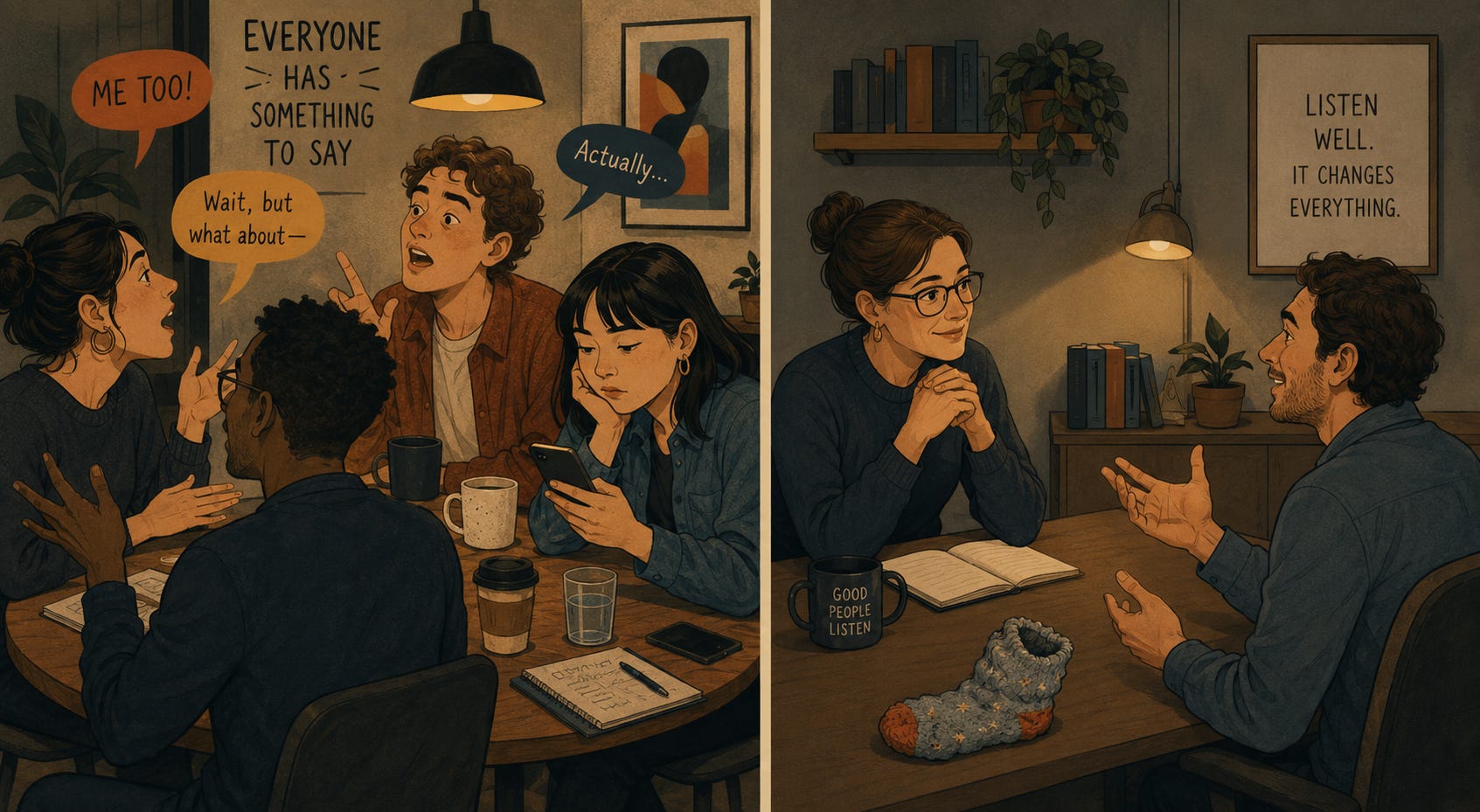
Watch any lively conversation and you’ll see it happen within minutes. Someone is four words from finishing their thought and the person across from them is already talking. Not responding. Talking. The talking sock gets grabbed before the speaker is done, and nobody seems to notice, or care, because everybody in the conversation is waiting for their turn rather than listening for what comes next.
My parents drilled the opposite into me when I was a little shaver. You don’t interrupt, young man. You wait. You let the person finish. It wasn’t a suggestion. It was a family standard enforced with consequences that eventually morphed into a big part of my character. Or a character flaw to some.
Thirty years of technology support turned that parental order into a professional methodology.
Here’s what actually happens when a client starts describing their problem. Within two sentences, experience has usually handed me the answer. Something clicks, a pattern from a dozen previous consultations surfaces, and I know where this is going before they do. There’s a quiet relief in that moment, not arrogance, the relief of someone who has been afraid of not knowing the answer and just found out they do. I hold unreasonably high standards for myself as a professional. Knowing the answer after sentence two means I haven’t let anyone down today.
And then I do something that runs completely against instinct.
I keep listening.
Not performatively. Not with the glazed patience of someone waiting for their turn to speak. Fully, alertly, with the specific intention of finding out what question to ask next. Because the thing I’ve learned across thousands of consultations is that the client’s third and fourth sentences are where the real information lives. The first two sentences describe the symptom. What comes after describes the patient.
Most people listen to respond. I listen to find out what question to ask next.
The mental red-lining, the urgent internal pressure to solve the problem, slows the moment I have the answer. What replaces it isn’t relaxation and disconnection from the person speaking to me. It’s a different kind of attention, a consistent alertness scanning for secondary and tertiary information, anything adjacent to the original problem that experience tells me might matter. I’m not targeting one malady. I’m scanning the whole body.
A faculty member contacts me. Something isn’t working in their Canvas course, but it worked before. I ask a few questions about their technology landscape, what device they’re using, what browser, what operating system. They tell me they’re on a MacBook with Safari and their OS is up to date. I take that at face value and keep troubleshooting. But experience has shown me something about faculty devices at universities: some of them are old. Not the person, mind you, their equipment.
So I ask one more question. How old is the laptop? When did they get it from the university?
They don’t remember.
I ask them to click the Apple icon in the upper left corner of their screen and select “About This Mac.”
They read me a macOS version number that is six generations behind current.
Bazinga.
Canvas unfortunately doesn’t work with a Safari browser on a six-year-old macOS device. Now we’re having a completely different conversation than the one we started with. This is not going to be a quick fix, and I need to gently prepare my client for an unexpected diagnosis. I need to initiate a discussion about upgrading the operating system to the latest version the hardware can support, or replacing a device that has quietly aged past its useful life. This discussion means I may have to recommend involving their department IT support person, who has their own work style and professional agenda and timeline in the solution, and the faculty member’s afternoon just got significantly more complicated than they expected when they initially contacted me.
That conversation only happened because I kept listening past the point where the first answer appeared.
My faculty client wasn’t lying when they told me the laptop’s OS was up to date. But “up to date” meant something different to them than it means to me, and the gap between those two definitions only surfaces if you ask one more question. A conversational card nobody knew was in the deck.
I think about this every time I’m in a consultation. The client came with a shopping list of needed fixes. My job isn’t just to fill a bag with the items they put on the conveyor belt. It’s to fill the bag and throw a couple of fresh juicy apples on top for the drive home. Something they didn’t know to ask for. Something experience told me they needed before they knew they needed it.
Being heard is a gift given from someone who cares about the person beyond simply nodding along while minutes float by. It’s a choice someone on the other side of the screen or the table makes to pay close enough attention to catch what the client didn’t know they were saying.
Most people listen to respond. The client who gets heard gets something better than a fast answer.
They get the right one.
More later...