
The fifth one confirmed it for me.
Four email responses before it, I’d read the same words and it never registered with me — “Awesome! Thank you so much,” “This was SOOOOO helpful,” “I watched it three times” — and filed them somewhere between relief and exhaustion. But the fifth one made me exhale for the first time in three weeks. Not because the praise was louder. Because I finally believed it wasn’t a fluke.
It was back in Spring 2020. You might remember it being the time when education left the classroom and went fully remote. I remember it as an incredibly stressful season in my career. My university had two weeks to move two thousand faculty members from in-person instruction to fully online. Colleagues were running back-to-back group webinars across a very busy quarter break doing the impossible work of getting an entire institution functional on a platform many of them had only used to augment their in-person pedagogy. For a number of months, I felt like a tutor in the help center — the one faculty came to after the group sessions, confused about the thing they’d been shown once and couldn’t find on their own.
Sound familiar?
Instead of being present in the group seminars, my role was to manage two email inboxes simultaneously: my own and the shared Canvas support inbox. What arrived in those inboxes was the full human spectrum of a profession in crisis. There were urgent requests from faculty who needed their course available to students before the term started and had no idea how to do it. There were panicked emails from professors who needed to create assignments and quizzes originating from Microsoft Office documents. There were emails with attachments — syllabi, slide deck presentations, and more — with an implicit expectation that I would place them in the appropriate area of the course, despite clear institutional policy that faculty own their course content and are responsible for building it.
And then there were the Zoom consults. One-to-one sessions with me, often follow-ups from the group webinars, where a professor would appear on screen and, in some cases, be in tears within the first three minutes. Not because they were failing. Because they were being asked to replace twenty years of standing in front of a room with a software platform they’d never needed before, and nobody had told them it was okay to feel like it was too much to take on.
I gave them that space. Every time.
By two o’clock most days, I had processed over a hundred emails, with more arriving faster than I could reply. As I was firing off replies, I kept returning to a mental image of the post office on Christmas Eve — a line of people out the door, each one holding a wrapped package needing to be delivered in time for the holiday, and one worker behind the counter moving as fast as humanly possible.
Somewhere around week two of Spring quarter, I realized I needed a smarter answer. Not a faster one... a smarter one.
The problem wasn’t my typing speed. It was the nature of the requests themselves. Every faculty member had built — or was building — their course differently. Teachers have full agency with their course design, which means no two courses look alike. A knowledge base article that says “click Settings, then change the Participation field” assumes the reader can find Settings, knows what the Participation field is, and has the cognitive bandwidth to translate written instructions into action on a screen they’ve never navigated before. In Spring 2020, those were not safe assumptions.
So I tried something different. Steering into the skid, if you will.
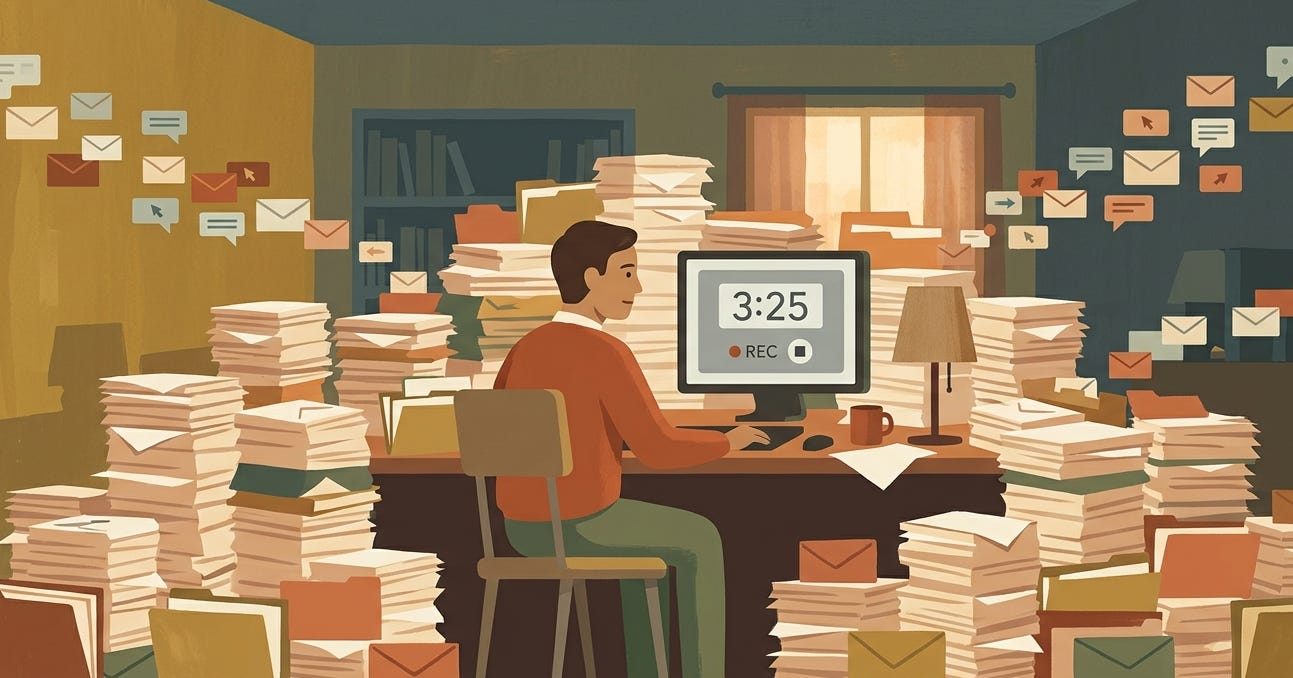
Picture a two-minute narrated screencast. A greeting with the recipient’s first name, like how I’d greet them arriving at our table at a coffee shop. Their specific course visible in full screen view. My calm and conversational voice walking them through exactly what to do, in exactly the right order, with exactly the right level of explanation for someone who was not a Canvas expert. When I finished with, “Let me know if you have any follow-up questions. Hang in there with everything. Have a good day.” and stopped recording, the software uploaded it to the web and opened a unique URL in my browser tab. A text snippet populated my reply with the link and a single sentence of context, I pasted that unique link, and hit send.
The whole thing — recording, upload, reply — took three minutes and twenty-five seconds.
I want you to think about that timeframe. Three minutes and twenty-five seconds, start to finish, for a personalized, narrated, step-by-step walkthrough of a specific problem for a specific person in their specific course. Now I want you to compose an email in that same window — write the greeting, explain the steps in text, format it with bullet points, find the web links to relevant knowledge base documentation, spell-check it, grammar-check it, re-read to make sure you didn’t accidentally tell them to click something that doesn’t exist anymore — and tell me you got there in under four minutes.
Go ahead. I’ll wait...
Here’s the part no one saw coming: My disclaimer.
Midway through each screencast, if I chose to make a change to the client’s course on their behalf, I would say something like:
Now, while I never make changes to a professor’s course without prior permission — with your best interests in mind, I’m going to set this up for you based on what you described in your email. Should you want to yell at me for doing something to your course without your permission, do let me know.
That line got laughs. It was supposed to. But it wasn’t just a joke.
After thirty years of working for institutions more interested in covering themselves than trusting their people, I had learned to protect myself too. The disclaimer was my armor. If someone complained up the chain, I needed a documentation trail that showed I’d acted in good faith on their stated request. The humor was a wrapper around something I had genuinely learned the hard way: in an organization that worries about upsetting one customer, you protect your work or nobody else will.
The tragic irony is that the clients never knew that. What they experienced was warmth, humor, and someone who cared enough to record a video just for them.
Make no mistake: management was not the enemy. They showed up the way institutions show up in a crisis — with good intentions and limited usefulness. “Let us know if there’s anything you need.” They meant it. But what I needed was for someone to understand the Canvas platform well enough to actually help, and that person didn’t exist in the organizational chart above me. Additional staff from other departments were brought in to help with shared inbox volume, but they could only handle the simple, low-complexity requests. The complicated ones — the ones that required judgment, contextual knowledge, the ability to read between the lines of an anxious email, and the mental rolodex of knowing their clientele from years of support interactions — those stayed with me.
What I also needed in this arduous season was permission to protect my own mental space. This I had to give myself.
I stopped at my scheduled end time. Every day. Even when the inbox wasn’t empty — and it was never empty. I took my lunch away from my computer, and watched old Tex Avery cartoons and ‘80s MTV rock videos, as a deliberate act of self-preservation. I needed to reflect on happier things, the things I absorbed from the days of my youth. As the uncertain overwhelming days and weeks progressed that spring term, I observed something important. My clients’ emails were being sent at ten or eleven o’clock at night, because that’s when they were working. The asynchronous nature of the screencast format turned out to be a feature, not just a convenience. They could watch when they had the bandwidth for it. I could record when I had the bandwidth for it. Nobody had to find thirty minutes of overlap on a calendar that didn’t exist anymore to meet live-time.
That realization — that I could provide a specific number of live one-to-one consultations and handle the rest through screencasts — was the moment I stopped drowning and started swimming.
After four academic terms, the two inboxes had processed somewhere in the neighborhood of thirteen thousand emails. And I logged many hours in one-to-one conversations with my faculty clients. My colleagues had held hundreds of hours of group training. That rock got successfully pushed up the hill to the top. We had moved two thousand faculty from in-person to online instruction in the time it normally takes to plan a conference.
What management feared most about the screencast approach — the lack of standardization, the impossibility of pointing everyone to the same resource — turned out to be the gleaming evidence. One size doesn’t fit all with Canvas support because no two courses are built the same way. The personalized video wasn’t an inefficiency. It was the only honest answer to what the question actually was.
I still make those narrated screencasts. Six years later, every single one is different, and every single one takes about the same three minutes and twenty-five seconds.
The fifth rave email was not a fluke. It was the methodology, working exactly as intended.
More later...