
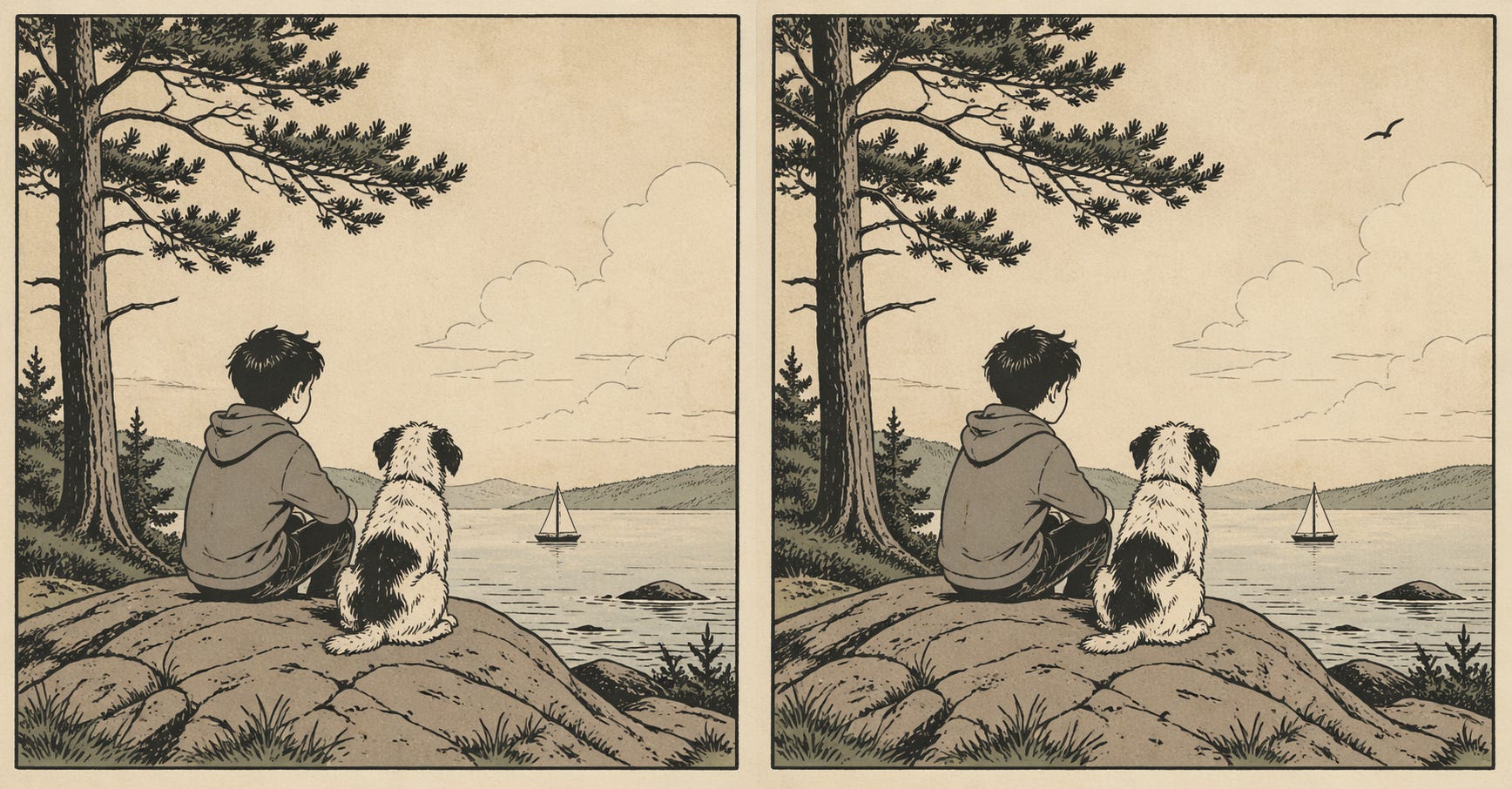
When I was a kid, I was the one who finished the spot-the-difference puzzle before anyone else at the table had picked up their pencil. Two nearly identical panels sitting side by side, and somewhere in there a lampshade had lost its stripe, a clock had gained a hand, a bird had quietly vacated a branch. Most people scan both panels and see the same picture twice. I couldn’t not see the difference. The mismatch announced itself.
I didn’t know then that I was building a professional superpower. I just thought everyone saw what I saw.
They don’t.
There is a version of technology support that looks like this: a ticket comes in, a link gets pasted, the ticket closes. Another ticket comes in with the same question. Another link gets pasted. Wash, rinse, repeat until Friday. This ain’t laziness, it’s obedience. The institution built a system that rewards closing tickets, not preventing them. So that’s what gets done. Nobody ever got a performance review that said “Outstanding work not generating tickets this quarter!”
The system doesn’t encourage you to notice. It wants you to respond.
I spend a significant part of my day inside Instructure Canvas — clicking into courses, masquerading as faculty accounts to see what they see for support purposes, and performing administrative tasks that are never ticket-worthy because the client never knew they needed them. I’ve been doing this for nine years. Believe me, I know what Canvas looks like. I know what it looks like at 8am on a quiet Tuesday and what it looks like the morning after Instructure deployed an update over the weekend.
One Monday morning I clicked my bookmark to load my Canvas dashboard, and noticed something was wrong.
The global navigation menu — the blue vertical column that sits on the left side of every Canvas account, the one that never changes — had a new icon in it. I have looked at that column approximately ten thousand times. I’m not joking. I know what belongs there. This new icon did not belong there.
I did not wait for a ticket. I did not wait for a colleague to mention it in our Microsoft Teams channel. I did not wait for my inbox to fill up. I immediately started drilling down to the area in the administrator zone where I could disable this icon for all personnel.
Something in that weekend’s update had misfired and enabled a feature that had no business being enabled. One checkbox, checked by accident, visible to every client at every institution that received the same update.
I unchecked it, I verified it was gone, I took another sip of my water bottle, and moved on with my morning.
The course navigation menu in Canvas is a different story. A potentially volatile story. Unlike the global navigation column, which most faculty ignore the way you ignore the margins of a page, the course navigation menu is where faculty live. It is the left-side list of links inside their own course. They customized it. They see it every morning and know what belongs there.
On two separate occasions I have clicked into a faculty course to perform a requested change, noticed something unexpected in that navigation menu, and felt the split-second alert that nine years of pattern recognition produces. Something is off. I opened three random courses in the active term. Same unexpected item in each course. Instructure had pushed an update, and the update had quietly added a menu item to every course navigation menu at my institution.
I didn’t wait for the emails. I knew they were coming. Faculty notice when their course navigation menu has something unexpected in it. Faculty email me immediately, and they do not email me one at a time. It’s a dogpile of messages.
I went to my admin zone. I found the checkbox located in a different area than the global navigation menu glitch. I unchecked it. I verified in those three random courses that it was gone. By the time the first faculty member logged in that morning, the anomaly had already been eliminated.
Here is what the alternative looks like.
The institution that doesn’t notice finds out about Instructure’s oops the way institutions always find out: the ticket system’s inbox queue is flooded with the same issue. The help desk begins the copy-paste response. A content-approved alert gets published to a centralized IT support webpage. The same explanation goes out twenty times, then forty. A manager or director in a project coordination meeting will not hear about it until the weekly team meeting, assuming someone remembers to bring it up. The ticket, meanwhile, has to find its way through the routing system to the one person with the administrative rights to actually fix the underlying problem. That routing takes time. During that time, clients get grumpy. The help desk is drowning. The fix that takes thirty seconds once it reaches the right hands has been sitting in a queue for two hours, maybe three.
All of it — the tickets, the routing, the status updates — exists in large part to manage problems that a different kind of attention would have prevented.
The institutional machine is enormous. It kicks into gear the moment the ticket system’s inbox fills up. It never asks why the inbox filled up.
Here is where things get absurd. A technologist who prevents the wave doesn’t just go unrecognized — they may actually look underperforming! Fewer tickets closed? A quieter queue? Less volume to point to at the end of the week? The institution’s efficiency criteria has no instrument sensitive enough to detect what didn’t happen. It can only count what did.
The tech who let the wave hit and spent the day copy-pasting has the numbers to show for it. The one who stopped it before breakfast does not.
Nobody sat in a conference room and decided to penalize prevention. The institution built a system that measures response, assumed response was the job, and has been faithfully measuring it ever since. This flaw isn’t malicious, friends. It’s structural. Which is somehow worse.
A technologist who notices — who has trained their pattern recognition across years of daily immersion and brings that instinct to work every morning — is an institutional asset of a kind that no performance review ever captured. Observance and proactivity are not personality quirks to be tolerated. They are professional traits worth celebrating. The value is not in the tickets closed. It is in defusing bombs before they go off.
Trendspotting is never a skill that appears on a job posting. Nobody advertised for a Canvas administrator with hyperobservational pattern recognition and a childhood gift for spot-the-difference puzzles. The institution hired me to manage an LMS. The institution measures tickets closed, response time, and client satisfaction scores.
The spot-the-difference kid grew up and went to work inside a complex system, and every morning he logs in and looks at it the same way he looked at those two panels as a child. Not because anyone asked him to. Because he cannot not see it.
The mismatch announces itself. And then, quietly, it disappears.
More later...