
Nobody is born a monk.
The hooded robe and the Gregorian chant come later in life, not the beginning. There’s a person who lived a life in the world the monk eventually walks away from. There are decades of wanting things, chasing things, believing things would solve problems that things were never built to solve. The vow of simplicity isn’t a starting point. It’s an arrival, and it takes a long road to get there.
Mine started with a different vow entirely.
In 1997, I was twenty-four years old and freshly hired by a university in Bellingham, Washington. I made myself a promise: work five years here, then get a bigger job with better pay somewhere around Seattle. The plan had a deadline and the deadline had a purpose. Bellingham was the launching pad. It was never supposed to be my destination.
When I was twenty-nine, I’d torn my ACL and meniscus playing rec league softball. I told myself it was from over two years of barefoot umping, spinning, and leaping in Tae Kwon Do training that wore the joint down until, after getting my black belt, a quick twist on the softball field finally popped it. With my 30s decade coming up soon, I found myself with a mortgage on a home, active in two or three softball teams on weekends, a decent social life, and a stable job with a twelve-minute commute through a town with water and mountains a quick drive in either direction. I was, by every measure that mattered to me at the time, doing well.
That five-year deadline came and went, and I didn’t even notice.
Nobody asked me to stay in Bellingham. There was no dramatic lightning-bolt event or a single moment of clarity. I just realized what I had, mountains, water, a job I’d gotten good at, a town small enough to know and big enough to live in, and asked myself a question I didn’t know I’d been avoiding: was this enough? The answer turned out to be yes. I spent the rest of that decade and the next confirming it. Medium-size town. Medium-paced life. Visit the big city when you want it. I didn’t need to live there.
But the elusive “enough” wasn’t the only thing I was chasing in my twenties and thirties, and the other thing took a lot longer to figure out.
I spent my bachelor years convinced that things would make me wanted by the single ladies. Wanted, specifically, in the way that leads to a second date. I bought technology I told myself I needed for professional competence, research, staying sharp, staying current, while my credit card balance loudly argued with my story. I socialized with friends who often said, “most toys wins,” and they had the disposable income to win every time. I tried to compete on a budget that didn’t support my friendly competition, because some part of me believed that having enough stuff would eventually translate into being enough as a person, including to the women I hoped might find that version of me worth dating.
I eventually learned that it was never about the stuff. It was about me, whatever I actually brought to a table in a restaurant or a seat at the bar, that made someone want to stay and learn more. The gadgets weren’t doing any of the work to get a woman interested in me. They were just expensive evidence that I hadn’t figured out how to introduce “me” yet.
Somewhere in my thirties, I started figuring it out. The acquisitions of the “new shiny” slowed, and I gained the confidence to stop entering the competition. The devices that remained started getting appreciated on their actual usage benefits instead of on what they might communicate about me to someone else.
That should have been the end of the story. But it wasn’t.
I didn’t notice the shift in where technology was going for a long time. What used to attract me to open my wallet for a new device was the appeal of a tool that could do something nobody had been able to do before. That justified the enormous payment and was worth the credit card balance in my thirties. But somewhere over the following two decades, the bargain quietly flipped. The wonder didn’t disappear, but it got buried under something else: every new device, every operating system update, every account I created required something of me. Telemetry. Access to my exact location when and where I used it. A permanent thread connecting my daily life to someone else’s advertising algorithm.
I kept buying anyway, because the wonder was still technically present, and because by then “staying current” had become its own justification, the same way “research” once was.
It wasn’t until my fifties decade, which started two or three years ago, for the actual cost to become apparent. Not the financial cost, the cognitive one. Every device I owned had become a small ongoing tax on my attention: updates to track, settings to manage, operating system nuances to keep straight across half a dozen pieces of hardware that were each quietly trying to learn more about me than I wanted them to know. None of it was buying back the thing I actually wanted, which was mindspace, room to think, and time for contemplation instead of maintenance.
That’s when the word monastic came into my life.
Where I lived taught me what enough looked like in 2002. The bachelor years taught me, slowly and sometimes painfully, that it was never about the things at all. And technology, last of the three, taught me that wonder morphs into dread if you’re not paying close attention. The cost of not noticing isn’t measured in dollars, it’s measured in the lost moments of quiet you’ll never get back.
I didn’t arrive at Monastic Technology because I read about minimalism and found it appealing. I arrived at it because I spent three decades accumulating, in three different arenas, for three different reasons, and eventually noticed that none of the accumulation had ever once produced the thing I actually wanted. The drive for more went down. The happiness went up.
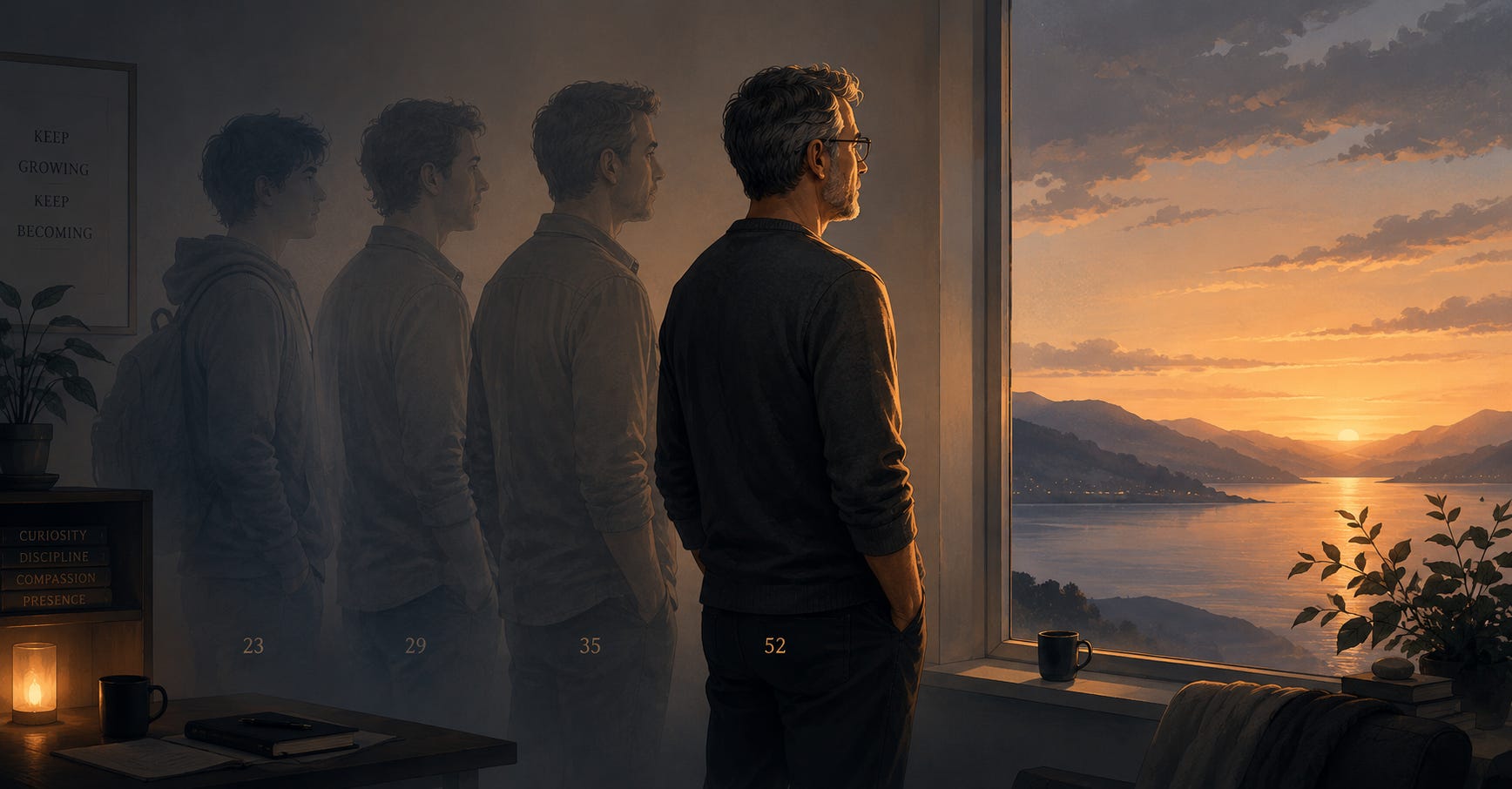
The monk wasn’t born in a hooded robe. He was a twenty-three-year-old with a five-year plan, a twenty-nine-year-old who noticed the view of the bay at sunset was already enough, a thirty-something who finally understood it was never about the stuff, and a fifty-something who realized his devices had quietly started taking more than they gave.
All four of those versions of me are still present within. But the 23-year-old, the 29-year-old, and the 30-something have gotten out of the way to make the 50-something’s quiet whisper affirmingly loud.
More later...