
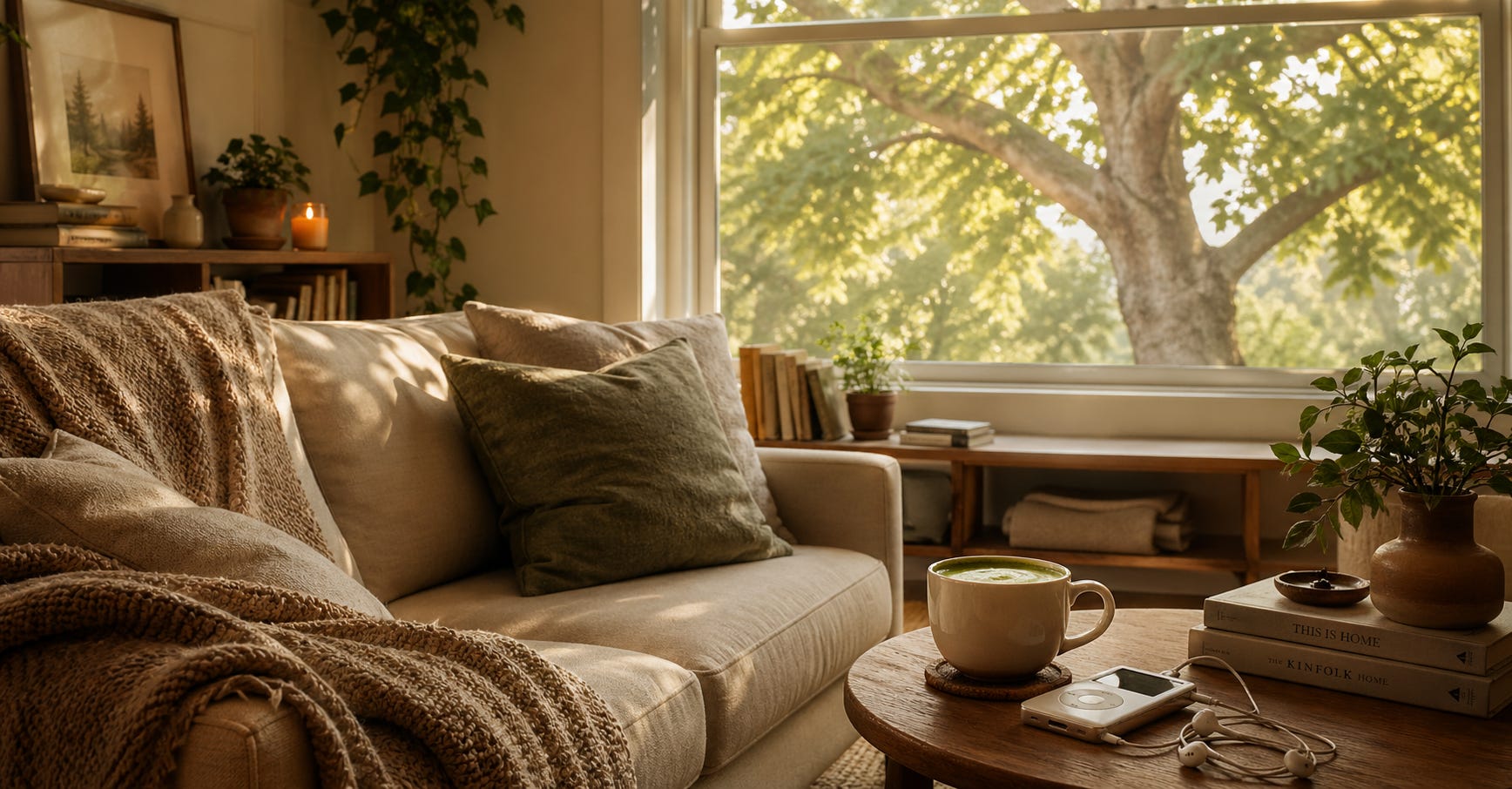
There are two versions of the living room in my house.
The first is a quiet Saturday morning. Matcha latte to my side, warm and unhurried. A big leafy tree in the front lawn greeting the weekend sunshine through the window. The Windham Hill Guitar Sampler from 1988 playing from a modded 1TB iPod Classic through a TwelveSouth AirFly into a Soundcore Boom bluetooth speaker. Music I have been listening to since I was a teenager expanding my music world by checking out all sorts of records from the town library, so deeply familiar after thirty-plus years that it stopped being just music and became atmosphere. It doesn’t ask anything of me. It simply holds an airy space with pleasant fingerstyle acoustic instrumentals to occupy the silent space.
The second is a contemplative Sunday evening. Berry-flavored seltzer this time. The street outside is darkened, a few cars parked along the curb, the weekend drawing quietly to a close. Paul Desmond’s Glad to be Unhappy is playing on the iPod, cool and unhurried. In my mind I am not in a ground-floor front room in a residential neighborhood. I am in a swanky penthouse apartment with a view of the city at night, surveying the week ahead from a luxurious elevation. The music isn’t background in this scene. It’s a thinking partner. What went well. What’s coming. What needs my attention before Monday arrives.
Same room. Same sofa. Same iPod. Completely different work.
I call this Monastic Technology. I used to call it minimalist technology, but that word got too popular in society somewhere around 2014 and I stopped using it. Monastic is the right word, and I earned it. In the summer of 2024 I spent time at a Benedictine monastery in Canada on a silence and solitude retreat. Something about that experience, the deliberate stripping away of noise, the practice of focusing on being present, the discovery that a quieter life is not a grotesque one, crystallized a philosophy I had been living in fragmented pieces for years. Personal devices stripped of distractions. Dedicated, deliberate use when I choose to use it. Very few notifications. Nothing running in the background demanding attention I didn’t offer.
The iPhone sitting across the room on the kitchen counter is the most visible evidence of the philosophy in practice. It handles calls, texts, podcasts, maps, a password manager, an authenticator, and personal email. No social media. No work apps. No scrolling. I’ll be the first to admit I’m addicted to a phone screen — the urge to connect, to be informed, to always be learning something, to be a competent technologist in a field that never stops moving. That urge is real, constantly nagging at me, and I’m not pretending otherwise.
But here’s the thing about working in technology for thirty years: I work at the ice cream shop. Any scoop I want, any time I want it, in quantities that would make a reasonable person queasy. The information, the feeds, the articles, the updates, the notifications — I have access to all of it, all day, every day, and the result is a consistent state of bloat. The nausea from too much eventually makes you avoid the stuff when you’re not working. The stuff, in my case, being screens.
And I work from home. Fully remote.
There’s no commute. No train ride where the nervous system begins to decompress as I look out the window at the rapidly-passing scenery. No fifteen-minute drive where the work-self slowly becomes the home-self. I shut down the work computer, turn around, and the personal devices are already there, same room, same four walls, same chair. The ice cream shop isn’t closed. I just change aprons.
Which means every boundary I establish has to be deliberately constructed, because my home environment provides none. The weekend listening sessions are not a bonus feature of my technology philosophy. They are the therapeutic healing from every cognitive hit my mind absorbs during the week. Aural Hygge — the Danish concept of restorative warmth and contented presence, delivered through sound. Saturday morning Windham Hill and Sunday evening Paul Desmond aren’t just pleasant. They’re how I repair the week’s damage so I can show up whole on Monday.
The iPod is the centerpiece of the strategy, and it deserves a proper introduction. It’s a sixth-generation iPod Classic, storage expanded to 1TB, a new battery with extra-long life, a custom Rockbox operating system with no reliance on Apple, loaded with a high-quality FLAC music library built from four decades of discography-deep research. No cloud-based streaming algorithm selected these artists. Every artist in that library arrived through deliberate pursuit — a record checked out from the town library at fourteen, a syndicated space-music radio program in the ‘90s where I kept notebooks of artists to research, a used CD store in a city I visited once, a recommendation from someone whose ears I trusted.
The algorithm will never know what my Saturday morning requires. It will never know the difference between the Windham Hill Guitar Sampler as ambient comfort and Paul Desmond as a catalyst for Sunday evening reflection. It would just serve me more of what I clicked last Tuesday.
I know what my Saturday morning requires. I’ve known it for thirty years.
This is what Monastic Technology actually means in practice. It’s the careful curation of an environment where the devices serve me, on my terms, when I choose to engage them — and stay quiet the rest of the time.
The sofa in the front room is where I do some of my best thinking. Not because I’ve optimized it with productivity tools or installed the right apps or subscribed to the right service. Because I built a space where the ice cream shop is genuinely, finally, mercifully closed.
The music plays, the tree does its thing in the morning light, and Monday is still two days away.
More later...