
In December 2019, my wife asked for one thing for Christmas.
She wanted me to read Jan Karon’s “At Home in Mitford” to her. One chapter a night, starting December 1, in the evening after everything was done for the day, as we approached bedtime. Karon’s book is a heartwarming story about an Episcopal priest in a small mountain town in North Carolina, surrounded by lovable quirky characters. My wife’s co-worker had recommended it.
So I said yes.
That was seven years ago. We finished the entire Mitford series, all 15 books. We then went through Jacqueline Winspear’s 18-volume Maisie Dobbs series after that. We’re presently on book 19 of Louise Penny’s 20-volume series about Quebec chief of homicide detective Armand Gamache. One chapter a night, sometimes two if they’re short. It morphed from a gift to a nightly practice. It’s what we do after brushing our teeth and swishing Listerine.
My wife likes my baritone voice. It puts her to sleep sometimes. My voice is not a bug, it’s a feature.
Here’s where the technology problem enters.
As we approach bedtime, bright overhead lights keep the brain awake which defeats the purpose of everything we’re doing, so the bedroom lights dim. I don’t like battery-powered clip-on book lights; they aren’t stable enough for shifting around in a chair, and the engineering is always slightly wrong in a way that irritates me more than the darkness does. So from the beginning, a backlit eReader was the obvious answer. I could see the words in a dimmed room, my wife could drift off to Armand Gamache solving murders in Three Pines, and the ritual would be protected.
Simple enough. Except finding the right device took six years and four attempts.
I started with a Kobo Libra. My reason for not choosing a Kindle was straightforward: I didn’t want to live inside Amazon’s walled garden of digital rights management, where the books I purchase aren’t quite mine and the device reports back to a mothership I didn’t invite into my bedroom. The Kobo was a reasonable first choice. It worked. But I grew tired of it in the way I grow tired of most devices once I’ve fully explored what they offer and mapped where they fall short. I sold it and kept looking.
The Onyx Boox Note Air 2 came next. It’s essentially a ten-inch black and white Android tablet, and it looked impressive on paper. Backlit screen, large display, plenty of real estate for a page of text. What I discovered in practice was that Onyx built their operating system primarily for note-taking with a stylus. Reading digital books felt like an afterthought, something the device tolerated rather than embraced. The OS was clunky in the specific way Android gets clunky when a manufacturer layers their own skin over it and calls it done. I flipped it on Ebay.
I downsized to the Onyx Boox Palma, which is roughly the size and shape of a mobile phone with a six-inch e-ink screen. Easier to hold, easier to navigate, more honest about what it was trying to be. The Android OS was still clunky, still carrying the Onyx note-taking DNA underneath everything, still not quite right. Better, but not it.
And then I heard whispers on the internet.
An overseas company called XTEINK was marketing a stripped-down eReader called the x4. Four-inch screen. No digital rights management. No unnecessary apps cluttering up the home screen. No app store. Load your books onto it via microSDHC card. Price: $80. The online community around it was small and enthusiastic in the way communities form around devices that do something specific very well and nothing else at all.
I bought one. The stock firmware was, as advertised by the community, not good. I followed the steps to flash a modded firmware developed and shared by people who cared about the device enough to fix what the manufacturer hadn’t. The new UI was clean and intuitive. The reading experience was exactly what I’d been looking for.
There was one problem. No backlight.
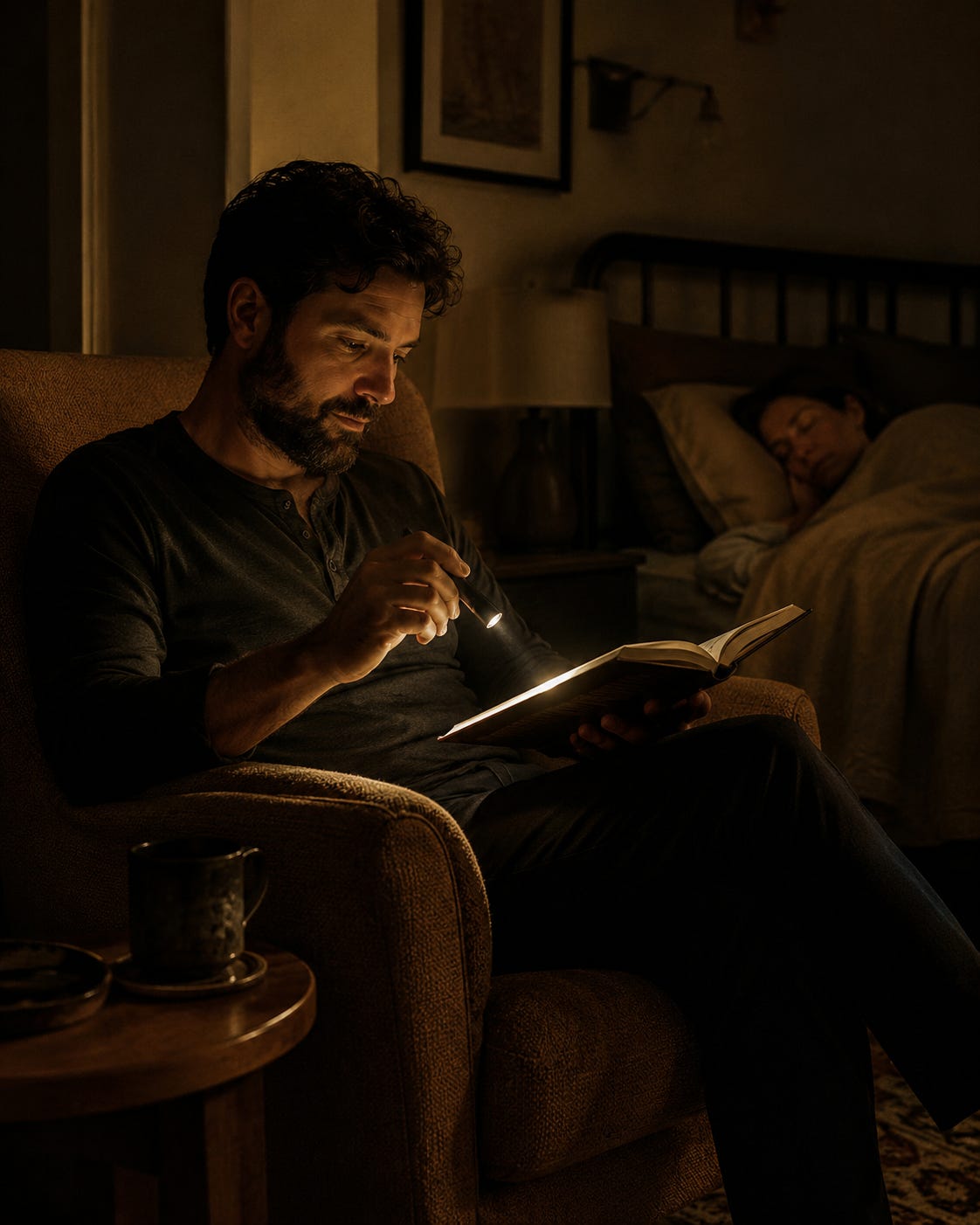
So now I read in the dimmed bedroom with a small LED flashlight to illuminate the page. Additional friction, yes. An irony not lost on me after six years of searching for the frictionless solution. But here’s the thing about the friction you choose versus the friction imposed on you: they feel completely different. The LED flashlight is my decision. The clunky Android OS was not something I chose. I tolerated it until I didn’t have to anymore.
When I hold the XTEINK x4 in the dimmed bedroom and click on the night’s chapter, I have an internal smile I can’t fully explain to anyone who hasn’t spent years caring about this particular problem. There is no telemetry uploading my reading habits to a datacenter somewhere. There is no mothership receiving a signal that I am currently on chapter 14 of “A World of Curiosities” at 10:47 on a Tuesday evening. There is no bookstore waiting to suggest my next purchase based on my reading history. There are no persistent software updates. And there is no AI guide recommending other books based on my reading history.
It reads books. That’s all, folks. It reads books.
Naturally, I’m aware of the built-in eReader book apps on Apple and Android phones. But I’ve learned that a separate, slim, stripped-down device allows a focus that can’t be had on a 2026 phone or tablet, no matter how much you modify settings to prevent distractions. This is what I’ve come to call Monastic Technology: not the rejection of tools, but the deliberate choice of tools that serve a single purpose and ask nothing in return. The phone that does everything is the ugly frame. The $80 device that just shows a book is the beautiful work happening inside it.
I spent six years and four devices looking for a tool that would disappear into a ritual my wife asked me to start on a December night in 2019. What I found was an $80 device with no backlight that I read by flashlight in a dimmed bedroom while my wife drifts off to the sound of my voice somewhere in the Quebec countryside with Armand Gamache.
My wife asked for one thing for her Christmas gift. I’m still giving it to her.
More later...