
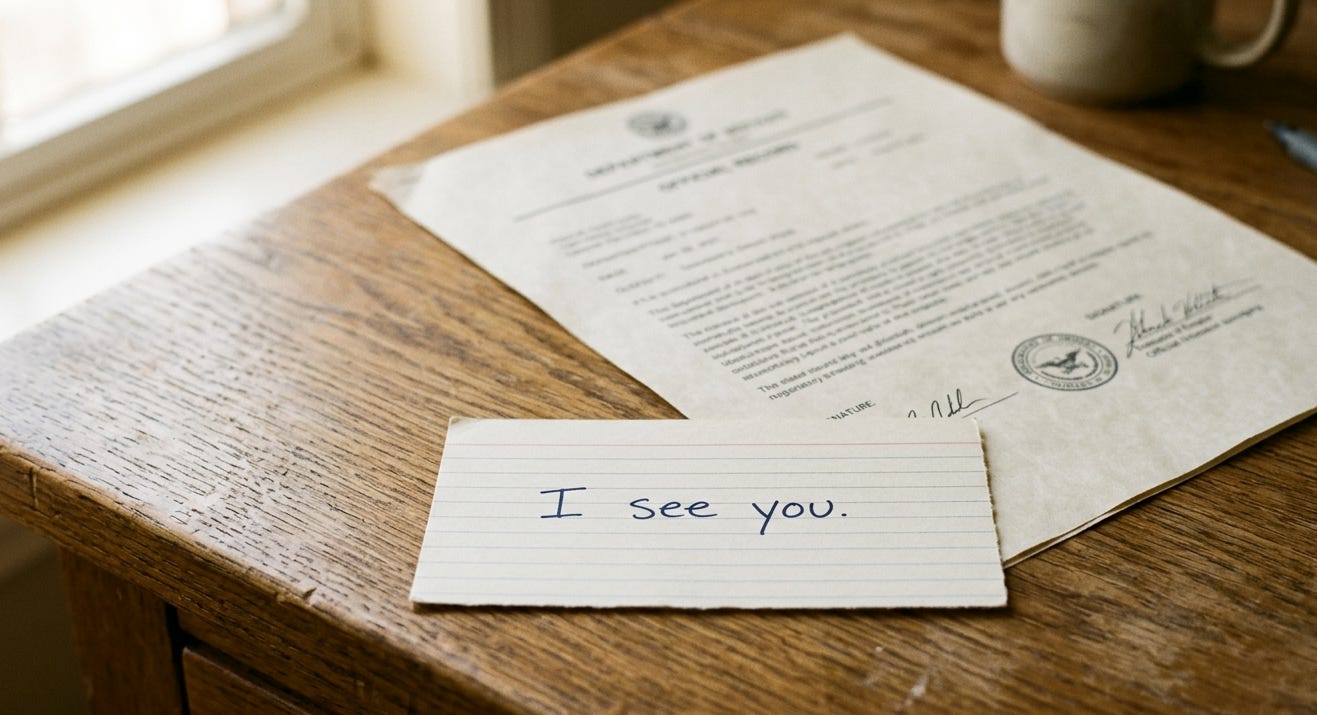
There is a sentence I have said hundreds of times, in person and in writing, over the better part of a decade. I have it memorized the way a surgeon has a pre-op checklist memorized. Not because I am reading from a card, but because the words matter enough to get right every time.
While I never make changes to a professor’s course without prior permission... with your best interests, and your students’ interests, in mind... I took the liberty of [what I did, specifically, for you].
Read it again. There is more engineering in that sentence than it appears.
The first part establishes the academic ownership boundary involving course content and signals that I know it exists. The second part names whose stakes are on the table; the teacher’s, and the students sitting in their course who never emailed me and probably won’t. The third part lands the work itself almost as an afterthought, because by the time I get there, the client already knows I acted from values, not impulse.
No form produced that sentence. No institutional policy committee drafted it. It came from thirty years of understanding how my faculty clients closely guard their course curriculum.
Management, at various points in my career, wanted forms. Authorized acknowledgments. Paper trails. The institutional reflex toward liability reduction is as reliable as gravity. When something goes wrong, the first question is always “do we have documentation?” The form is the answer to that question. Fill it out, get a signature, file it somewhere no one will ever look until the day someone needs to point a finger.
I understand the instinct. I just don’t agree with it.
Forms protect the institution. They do not protect the relationship.
A form says: My backside is covered. My sentence says: I see you. Those are not the same thing, and the gap between them is where most technology support goes heartbreakingly wrong.
The alternative I built is called the visual receipt. Instead of busting out an email with extensive descriptions of changes made to a course, a list of technical actions that would mean little to most faculty and nothing to the students whose term is on the line, I record a short narrated screencast. Two minutes, maybe three. I walk through exactly what I found, exactly what I did, and exactly why. The client’s first name, their course, their specific situation. Not a knowledge base article. Not a horribly-formatted ticket closure notice. A personal document made for them, delivered as a link in an email crafted to make them want to click it.
The institution wanted documentation. It got documentation. It also got a faculty member who felt like someone actually showed up for them, which is not something any form has ever produced.
That is not defiance. That is the same destination by a road the institution forgot to imagine.
Here is what I know after nearly three decades of tech support: the relational approach does not compete with institutional goals. It exceeds them. Lower friction. Fewer escalations. Clients who come back with the next problem instead of going around you or going silent. The visual receipt generates a paper trail and a grateful faculty member and a documented methodology and a client who now understands what happened to their own course. The institution got more than it asked for. It simply never thought to ask.
The sentence is how I protect the relationship. The visual receipt is how I honor it. And somewhere in the thirty years of doing both, I have built a list of people who can speak to my professionalism that no form could ever replicate.
That list is the real documentation.
More later...