
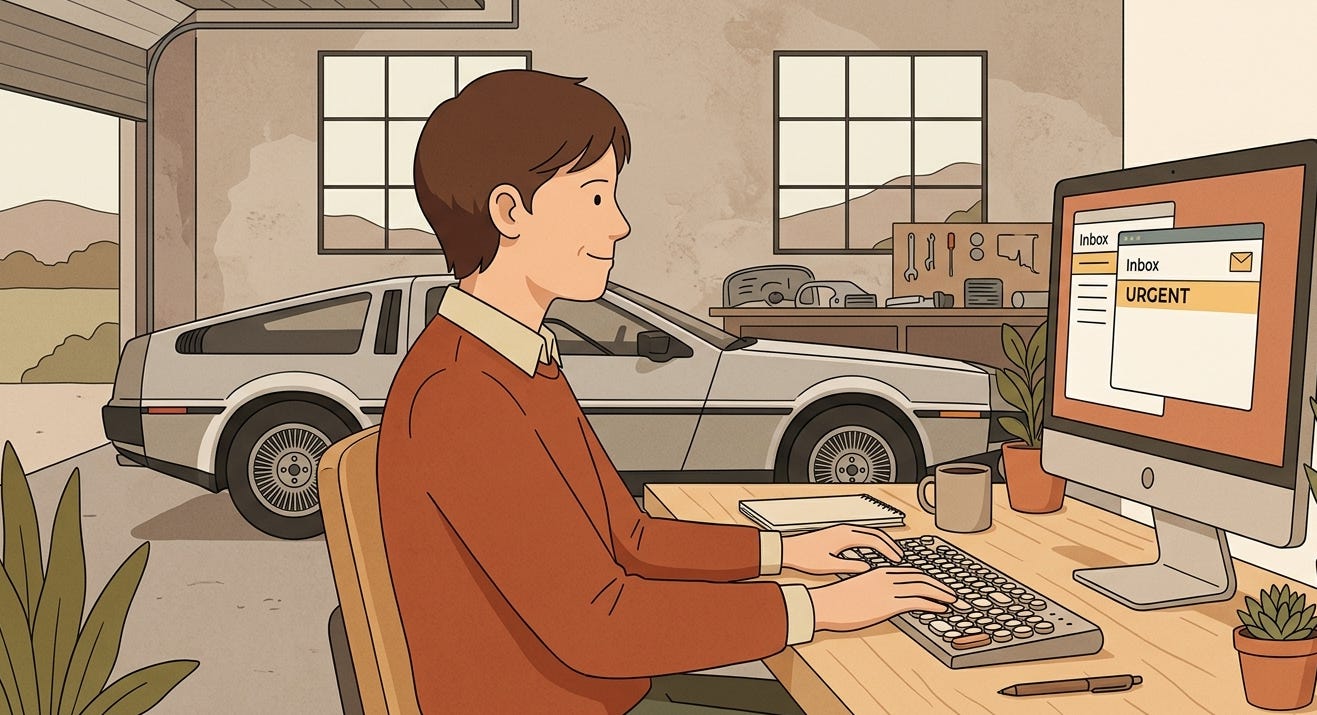
The subject line says URGENT. The body of the email confirms it — exclamation points, fragmented sentences, the digital equivalent of someone grabbing you by the lapels. I read it once, nod slowly, and already know what happened before I’ve opened a web browser tab.
This is what nine years of pattern recognition feels like. The URGENT subject line isn’t chaos to me. It’s a signal I’ve seen before. I already know where the exit is. And I’m not gonna lie, it puts a big ol’ smile on my face.
Here’s the first flavor of Oh Crikey.
A teacher wants to do something kind for a student who missed a quiz. In their Canvas course, the teacher brings up the quiz, and assigns it specifically to that one student with a new start and end date. Benevolent intention. Catastrophic result.
What the teacher didn’t know — what nobody told them, because this is the kind of thing that lives in the fine print of a platform most faculty never dive into — is that assigning a quiz to a single student removes it from everyone else. The quiz vanishes from the student’s course view, and scores disappear from their gradebook. Then the emails start arriving from students. Lots of them, all at once. And finally, the distress beacon lands in my inbox with URGENT in the subject line. And their stress level goes way over 88 miles per hour.
I open the course. I open the quiz settings. I see exactly what happened. I click “Assign To,” select “Everyone Else,” set the start and end dates to something in the recent past since the original dates are gone, and click Save. I check the gradebook. Every score is back.
The whole intervention took less time than it took the teacher to compose their panicked email.
My email reply is calibrated to the person on the other end. For some, it’s formal and measured: “I think I spotted what was going on. I made some adjustments behind the scenes with your best interests in mind.” For others — the ones I know, the ones who’ve been in my corner long enough to receive the full version of me — it’s a smiley emoji and a link to their gradebook and: “I think we’re in a better place now?”
Effusive, gushing email reply arriving in my inbox in three, two, one.
Here’s the second flavor.
A teacher has been building content in their course for hours. Lecture notes, class to-do items, curriculum carefully organized, exactly the way they want their students to encounter the material. And then — a click in the wrong place, a confirmation dialog dismissed without reading, the specific brand of accidental that happens to everyone eventually — the assignment is gone. Possibly the gradebook column disappears with it. Student submissions, if there were any, apparently vanished into the void.
The email I receive is not calm.
What I know, and what the teacher does not, is that Canvas doesn’t actually delete things. Not immediately. Not permanently. Deleted content goes to a sort of purgatory zone — an area built into every course that is found in one of those hidden alleys that most people never visit. Every deleted item sits there with a date and time stamp, waiting. I navigate to that unmarked door, knock the secret knock, find the item by keyword and timestamp, and restore it. Content back. Scores back. Submissions back.
I tell every new client about this purgatory zone the first time we meet. I don’t wait for the panic. I actually delete a sample assignment — live, in front of them, while they watch with mild alarm — and then walk them through the restoration. “Now you might be thinking: ‘What the heck, Chris! You just deleted my assignment and all my students’ work. You jerk.’ If this ever happens, please exhale? And send me an email. I’m happy to help bring things back to their original location before they were deleted.”
It’s not verbally articulated, but I can sense my client thinking, “This is heavy. He’s my go-to guy.”
Here’s the third flavor, which requires a brief diplomatic interlude.
Two teachers share a course. They are both building content, which is as collaborative and occasionally collision-prone as it sounds. One teacher updates a content page. In doing so, they overwrite their colleague’s carefully constructed lecture notes. The colleague discovers this, does not immediately assume the charitable intention, and sends me an email that contains both a technical question and the faint outline of an interpersonal situation I will now need to navigate simultaneously.
Canvas saves a version of a content page every time it is saved. There is a page history — a complete record of every edit, with timestamps, going back to the beginning. I make a screencast. I walk the teacher through finding the history, reading the timestamps, identifying the version they want. And then, because this is the moment that calls for it, I reach for the cultural reference that has served me well across nine years of faculty support.
So if you don’t want your page to have this current content, you can take the DeLorean back in time to your previous saved version, click this button to confirm your decision, and blammo — your page content is back the way you originally had it.
And then, because the technical problem is solved but the interpersonal one is still sitting in the room: “Sometimes we are unaware of our partner’s edits in course content. I hope you won’t be too upset now that we know how to restore your content.”
I will get a big hug from their reply email and, occasionally, “I had no idea Canvas could do that.”
That phrase — I had no idea Canvas could do that — is the one I hear most often after a rescue. Not “thank you for sending a specific email confirming authorization for me to make changes to your course” or “I appreciate you reading the online documentation guide and following the proper procedures.” Just genuine surprise that the platform they’ve been using contains capabilities nobody ever showed them.
This is the part that management, bless their cortisol-soaked hearts, never quite understood about the personalized approach. The URGENT email isn’t just a problem to be solved. It’s a discovery waiting to happen. Every rescue is also an education. Every Oh Crikey moment is an opportunity to show someone that the safety net exists, that the DeLorean is parked right there, and I’m leaning on the door in a white lab coat like Doc Brown, lowering my sunglasses and saying, “Where we’re going, we don’t need to re-create Canvas content from scratch.”
I think we’re in a better place now.
More later...