
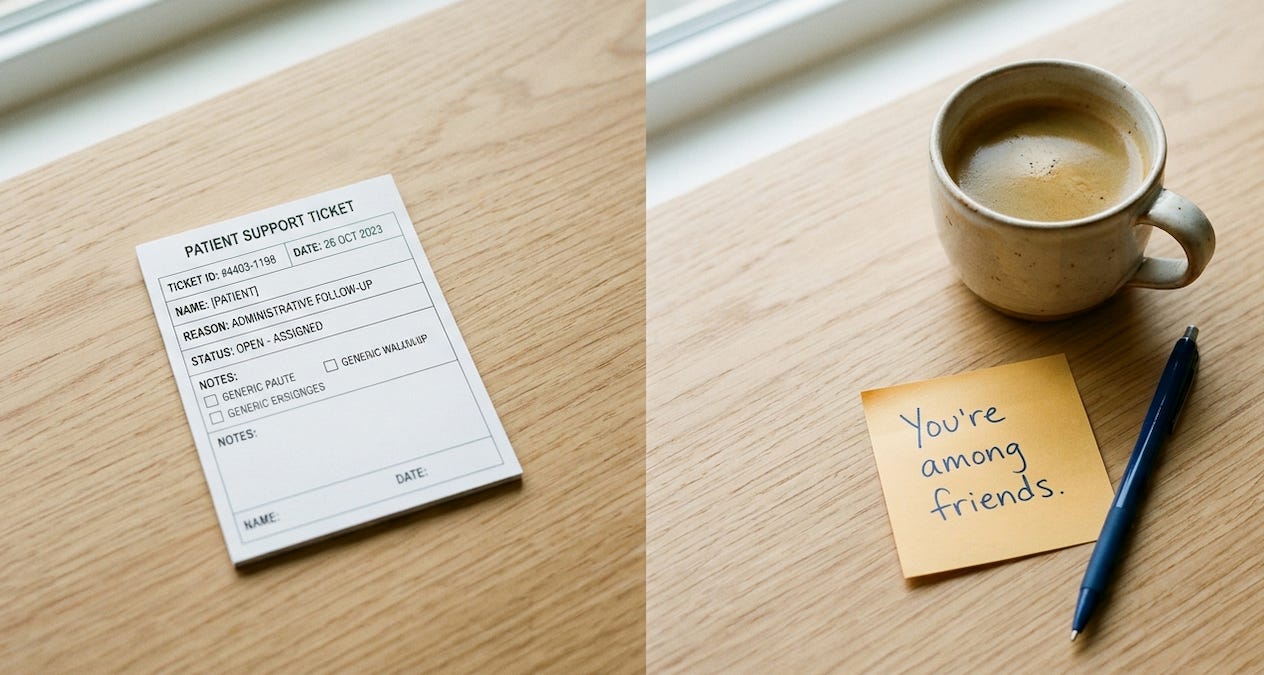
I looked at our university’s work ticketing portal recently. Here’s what a typical resolved ticket looks like: a copy-pasted block of instructions, edited for accuracy, stripped of personality, and signed off with “Best,” or “Thanks,” or nothing at all — just a name and a signature. Problem closed. Client served. Next.
That’s the model. That’s what they put in the book Tech Support for Dummies. That’s what future IT professionals are taught in their classes. Efficient, consistent, scalable, and completely devoid of any evidence that a human being helped another human being.
Well, I skipped the day they taught boring ticket systems in school. I had to do my hair.
Here’s what my consultations actually look like:
A faculty member arrives at my office, or in the Zoom meeting, carrying the quiet dread of someone who has to admit they can’t fix something. Before we even look at the screen together, I say, “Just so you know, there are a number of faculty who have encountered this same situation. This isn’t an isolated incident. You’re among friends.” And I smile. I watch the relief register. They aren’t stupid. They aren’t alone. The consultation can begin now.
We start working through the issue together. At some point, if they are the one controlling the mouse, they click the wrong thing. I don’t say “no, I said click here.” Instead I say, in a curious tone, as though we’re both discovering this together, “How about we click here?” They click. The thing works. And if they’re one of my elder faculty — and most of them are — I grin and say, “There we go! Now we’re cookin’ with Crisco.” They laugh. The tension that walked in with them ten minutes ago is gone.
When we’re wrapping up, I don’t say “Best” and close a ticket. I say, “Keep me posted on any abnormalities you encounter moving forward, okay? Always happy to meet again to take care of your course!” And sometimes, if the rapport is right and they’re in a lighthearted mood, I’ll swap “abnormalities” for “Oh, Crikey! moments.” It’s not in any manual. It’s not something they’d normally say. But it gives them a lighter word for the frustration they used to carry alone.
None of this is in a training guide. Nobody taught me to celebrate a small win with a phrase their grandmother would have used. Nobody taught me that the way you say goodbye determines whether someone comes back or suffers alone next time. I learned this the same way I learned most of what matters in my work — by paying attention to the person in front of me instead of the ticket created by them.
Every one of these small moments is doing the same thing my colleague’s “Best,” is not: telling the client that they are more than a ticket number, and that this relationship doesn’t end when the problem does.
More later…