
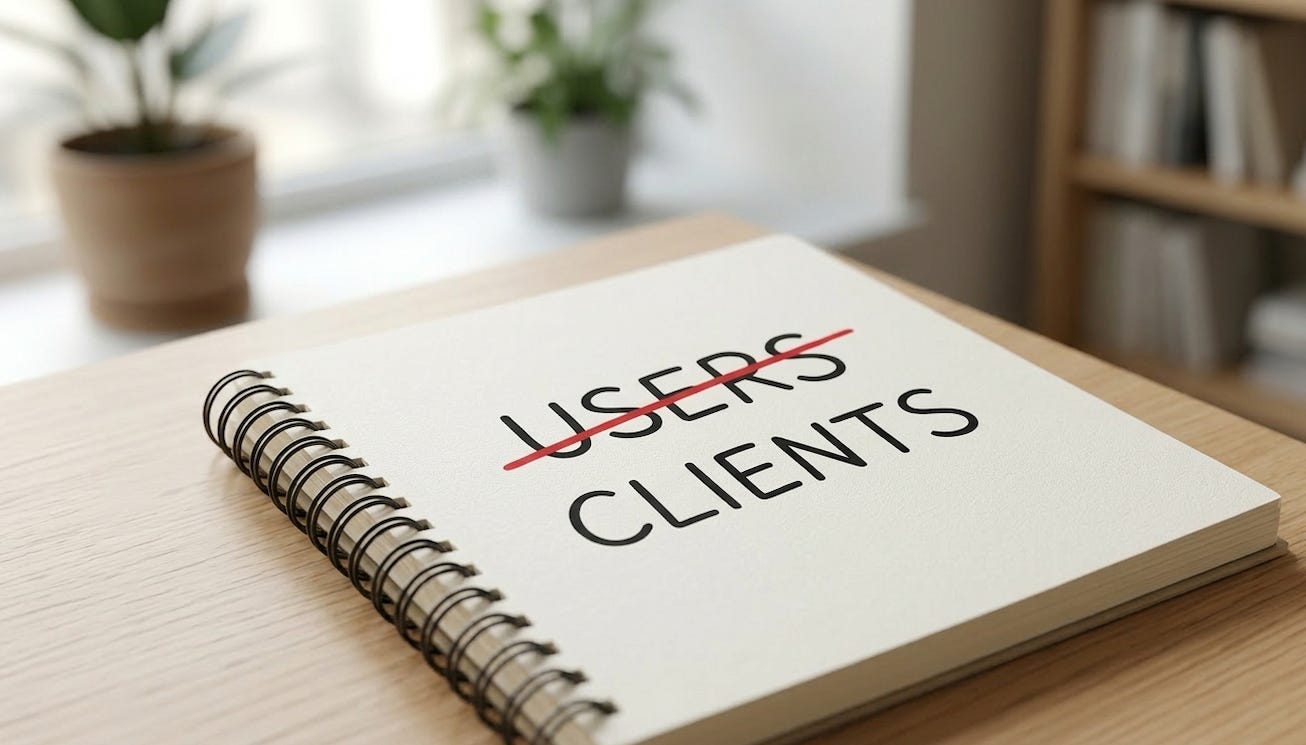
Someone once said there are only two kinds of people who get called users: people who use computers and drug addicts. This is a pretty controversial quip. I heard it years ago, and it has never left me. Not because it was clever, but because it was true. The word reduces a person to a behavior. It strips away everything else they are—their expertise, their dignity, their reason for sitting across from you in the first place—and defines them by the single act of needing help with a machine.
I stopped saying “users” early in my career. Instead I say “clients.” Some of the IT professionals in the university where I work thought it was a quirk. It was not a quirk. It was a decision about who I wanted to be in a room with another person.
There was another moment in my past that solidified my decision to use the term “client.” It was hearing an IT colleague refer to lower-level employees on the organization chart as “minions.” He said it casually, like it was funny. Maybe he thought it was. I did not. I heard someone with positional authority flattening other human beings into a punchline. From then on, I chose to treat my clients with elevated dignity.
Here is something most people in technology support have never stopped to consider: language is not neutral. Every word you choose in a support session tells the person sitting across from you how you see them.
“User” says: you are a function. You exist in relation to my system.
“Client” says: you are a person I serve. You have chosen to trust me with something, and that trust has weight.
I have spent my career making sure that the first words out of my mouth set a different tone than your typical IT support. I know what it feels like to be reduced by someone else’s shorthand. Most people do, if they are honest about it. We have all been in a room where someone else’s words made us smaller than we are. I decided that no one sitting across from me in a technology consultation would experience that feeling.
My patience with my clients is visible. The gentleness and grace shown is deliberate. Every time. When you hold technical knowledge over someone who does not have it, you are holding a small piece of power. What you do with that power reveals who you are.
Most people never noticed my choice of words, but a couple of faculty did. During a technical consultation, I was explaining steps to help resolve their computer issue, and they stopped me and asked out of the blue, “You never use the word ‘user,’ do you?” I told them why. They looked at me like I had just given them something small and unexpected—a moment of respect they did not know they were missing until someone offered it.
People do not always notice dignified treatment when it is present. But they always feel it when it is absent.
If you work in technology support, I would ask you to try something. Stop saying “users.” Say “clients.” Say “colleagues.” Say their name. Watch what changes—not in them, but in you. Watch how it shifts the way you prepare for the interaction, the way you listen, the way you speak. The word changes the relationship. And the relationship is the whole point.
More later...