
The email arrived the way they always do; vague, a little anxious, and missing some details I would need to actually help.
A teacher unfamiliar with Canvas. A peer review assignment that wasn’t behaving. A reference to the online documentation that, in her words, wasn’t showing her what she needed to see. And a closing “Please help?” that told me more about her frustration level than anything else in the message.
I didn’t send her a link to the same documentation she had already read. Instead, I asked a clarifying question. Which course, and which assignment are you referring to?
She replied with the course number. Just the course number. After nine years I’ve learned not to get bent out of shape about not giving me all the information I asked for. She assumed I would know which assignment she meant, because of course I would, I know everything. I’ve received this limited specification response before. I just ran out of omniscience pills today. No big deal.
So I sent a fourth email. I thanked her for the course number, because encouraging someone to share information is always worth the two seconds it takes, and then I made her an offer:
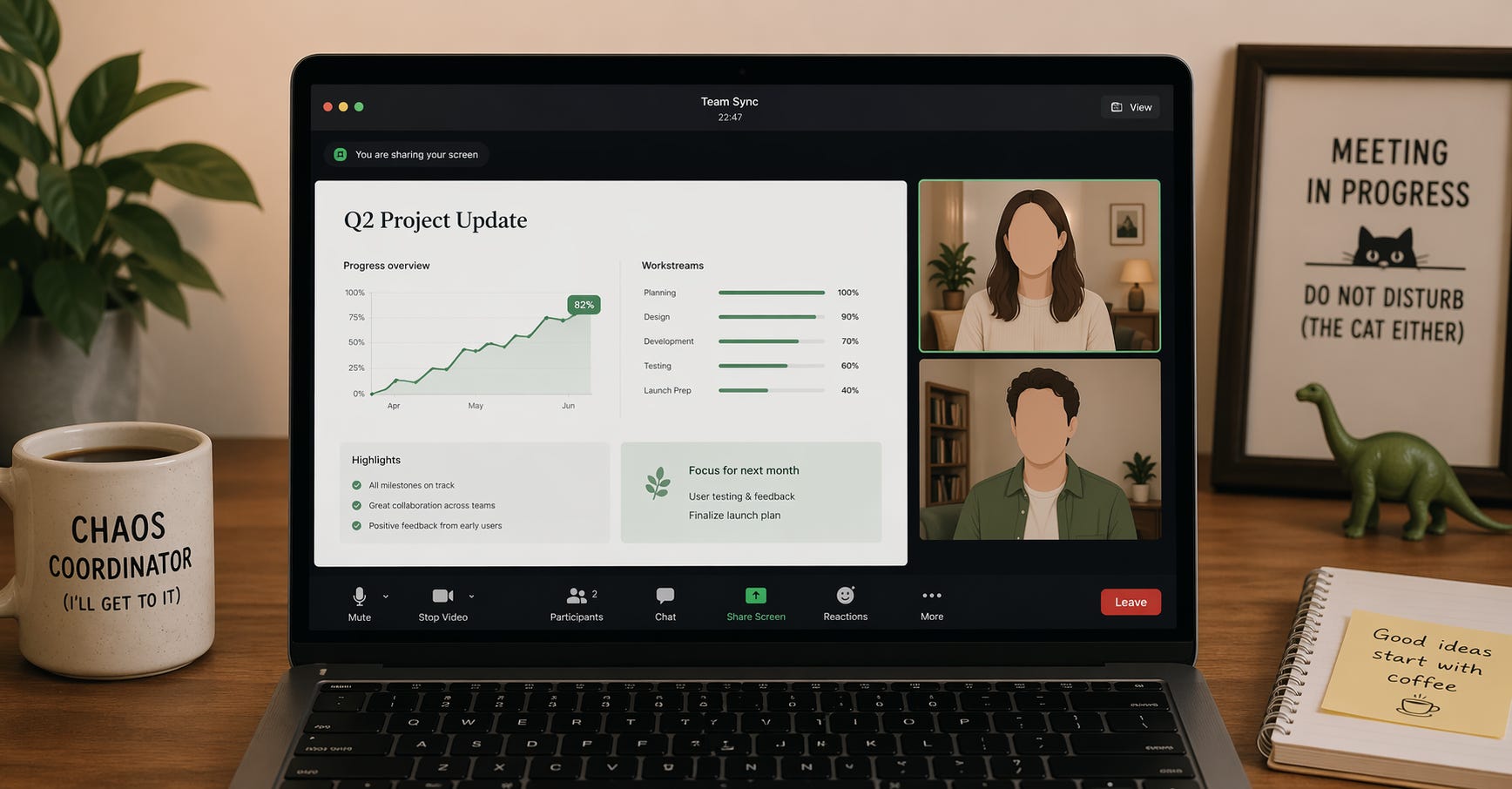
“Instead of a long-winded, bullet-point-filled email of technical directions that might put you to sleep, how about we meet via Zoom when our schedules permit? I can share my screen, we can walk through the steps in a demo course of mine, and then apply those same steps to your course and assignment. I think we can take care of business in 20 to 30 minutes.”
Within minutes, a confirmation of a consult reservation landed in my inbox, and she sent the reply email confirming she would.
What most people don’t see in that four-email thread is that I was already working. Not on the assignment. I didn’t have enough information for that yet. I was working on her. I was reading the vagueness, her word choice, the emotional register underneath the technical question. Diagnosing the shape of the support she needed before I had looked at a single item of content in her course. Some technical issues are a four-click solution, some are a two-minute “visual receipt” screencast to take care of a more detailed request. Peer review assignments are not a quick fix. Nine years of experience with peer reviews has shown me that.
Oh, the Zoom invitation offer? It wasn’t a pivot away from email. It was the conclusion of a diagnostic process my faculty client didn’t know was happening.
When she arrived in the video meeting the next day, I welcomed her and shared my screen. And without saying a single word, I let her see my Canvas dashboard.
Specifically, she saw Coach Beard’s Demo Course.
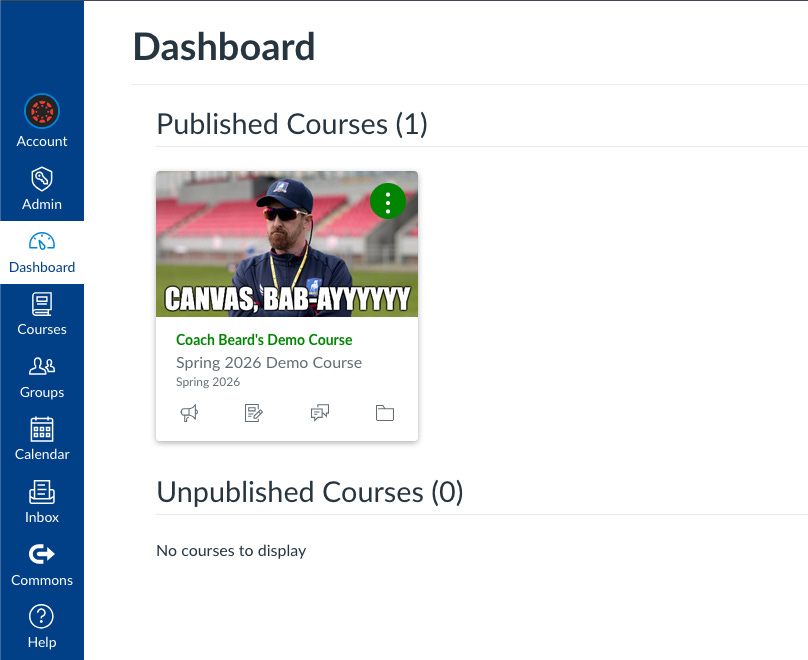
For the uninitiated: Coach Beard is a character from the television series Ted Lasso, and his face (stoic, bearded, magnificently unimpressed) greets every faculty member who joins my Zoom consults. The students enrolled in Coach Beard’s Demo Course are not pursuing degrees at my institution. Roy Kent is not enrolled anywhere near my university. Neither are Jamie Tartt, Dani Rojas, Sam Obisanya, or any of their teammates. Rebecca Welton has a Faculty Reviewer role. Nathan Shelley and Trent Crimm are both teaching assistants. Trent, naturally, is an independent TA.
This is not frivolity. This is architecture, folks!
A demo course with real student names would expose FERPA-protected information to a faculty member I am screen-sharing with, a violation I have no interest in committing. A demo course with placeholder names like Student One and Student Two would be accurate but completely soulless. Like a dinner consisting of saltine crackers. Coach Beard’s Demo Course does the compliance work and the hospitality work simultaneously. Before I have explained a single feature, the faculty member on the other end of the call has already chuckled and relaxed. They know what kind of person they’re dealing with.
Did you hear that? That’s the sound of anxiety leaving the room.
We walked through the peer review assignment process in my demo course: low stakes, no live students, nothing that would wreak havoc into her active term course if we made a wrong turn. I explained the steps. I showed the nuances the online documentation skips because corporations write for the general case and her course is a specific one. And then I offered her a choice: did she want to walk through the steps herself in her own course, or did she want me to help her?
I give people the fish or I teach them to fish. Their call.
Even though my fourth email in the exchange claimed we could get things done in 20 to 30 minutes, sometime around the fourteen-minute mark, with the peer review assignment working correctly in her course, she said it.
I had no idea it could be this easy.
I smiled. I told her I was so happy to hear that versus, “This was a whole lot of annoying nerd work.” She laughed. We wrapped up.
After the Zoom meeting ended and I shut my webcam off, I sat with it for a moment, the way I always do.
Because that sentence, “I had no idea it could be this easy,” is not a compliment about my technical explanation. It is an indicator of relief melting away. It is what comes out when someone who has been frustrated for days, quietly embarrassed that they couldn’t figure out the thing they were supposed to be able to figure out, suddenly has it working and realizes the obstacle was never as immovable as it felt. I didn’t just solve the problem. I dissolved the anxiety that had built around it.
And you know what? It fuels me every single time. I did a good job teaching a teacher, even though I am not an official teacher. I am appreciated for my knowledge and for sharing it. Every time I hear those nine words, they affirm something I have believed for a long time: technology support could be done better. Significantly better. Immediately better. Not with new software or a reorganized ticketing system or a revised knowledge base.
With this.
Here is the part that breaks my heart a little.
Nobody teaches this to undergrads pursuing a degree in IT. I haven’t found any YouTube channels dedicated to showing technology support professionals how to read an email thread as a diagnostic tool, how to build a demo environment that does compliance work and hospitality work at the same time, how to offer someone the choice between the fish and the fishing lesson. There is no online certification training for any of this. If there was, I’d have already achieved it.
What I do isn’t secret ninja skills learned at the top of a mountain in Tibet. It is basic human kindness. And a razor-sharp sense of humor.
The exhale after 14 minutes is available to anyone willing to show up that way. Most people just never found out it was on the table.
More later...