
Sometime in the early days of my career, I was having beverages with tech colleagues. With an ego approaching obnoxious at the height of my early-30s lack of filter in public, I blared the following declaration to the table:
When I stage a coup and take over my university, one of my first acts as Imperial Wazoo is to ban ‘urgent’ from all communications.
The table laughed. I didn’t smile, I meant every word.
That was then. I’ve grown as a professional since, and I’ve grown to understand the client’s perspective in ways my younger, invincible self hadn’t learned yet. I understand that when something breaks at the wrong moment, it feels urgent. The adrenaline spike is real. The frustration is real. The quiz you scheduled for your students starting in eleven minutes has somehow disappeared, and there isn’t time for a thoughtful, focused troubleshooting process to self-resolve the crisis.
Urgent means something specific. It means the situation cannot wait. It means delay causes irreversible harm. It means the building is, in some meaningful sense, on fire. Someone’s hair might be on fire too. I’ll grant that.
A Canvas gradebook is not on fire. Nor is graded curriculum.
Urgent often showed up in the subject line of email support requests early in my career. I noticed something about those ALL CAPS messages: it almost never described the situation accurately. It described the feeling. There’s a difference. “I am anxious and I need help” is honest and I can work with that. “This is urgent” is a demand wearing a descriptor as an armor-plated costume, and it loudly asks me to absorb someone else’s anxiety and let it reorganize my entire morning.
The external response was always calm, prompt, and professional. I didn’t lecture a tenured professor about word choice. I just didn’t let Urgent crack the whip on the work I was doing on their behalf. But make no mistake: my priority queue runs on relationships, context, and a few decades of pattern recognition. It does not run on adjectives.
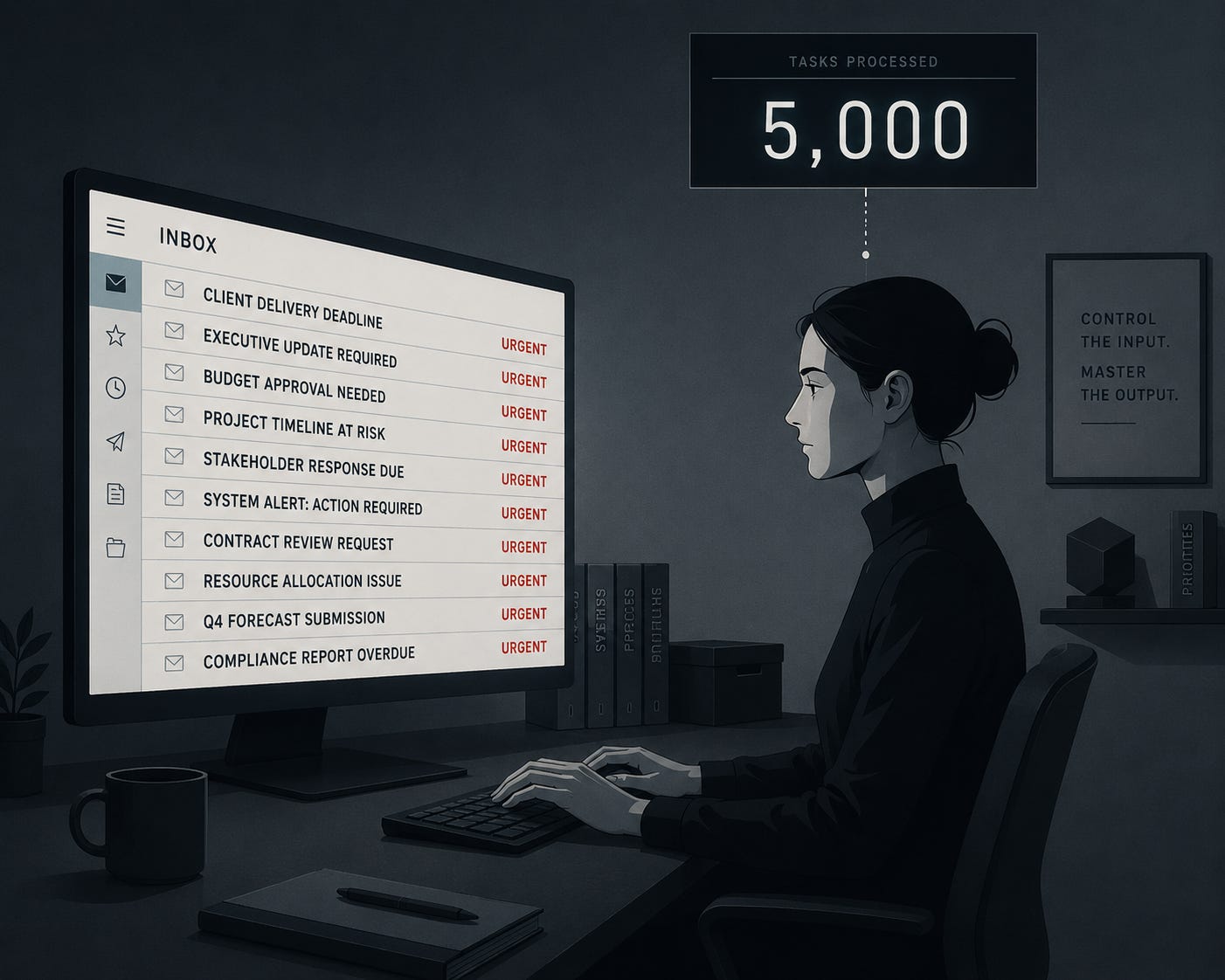
Here’s what the math looks like from inside the machine. I process roughly 9,000 emails a working year. I’ve been at my university for 28 years. That’s over a quarter-million emails coming into my inbox. Give clients the benefit of the doubt: two percent carry genuine urgency. That’s approximately 5,000 instances of anxiety landing in my inbox over a career, a Costco shopping cart on a busy Saturday, jumping the queue, knocking everything away at the front of the line so they can get their cart checked out before everyone else waiting in line.
If you haven’t learned by now, I’m a people pleaser by nature and I’m a professional burden-bearer. When a client’s anxiety arrives in my inbox, I absorb it and carry it until the problem is resolved. That means I’ve incurred 5,000 adrenaline spikes in my career at the university. Three a week, on average, for 28 years.
In my line of work, I can’t resolve issues any faster when there is Urgent in the email, like a sped-up timelapse of video footage. The other 245,000 emails got the same promptly-delivered response as the urgent ones. The word Urgent didn’t change my output. It just sent my adrenal system into overdrive.
Up until now, I’m confident most clients have no idea that’s happened to a technologist like me. I’m less confident it would change their behavior if they knew.
Supervisors aren’t in the business of tracking the toll elevated anxiety customer support takes on their subordinates. A manager’s mission is for consistent reliable work performance with no complaints reaching the level above them. My colleagues in the trenches understand it completely, but can’t change anything about it. So the pressure stays where it lands, on the person reading the all-caps subject line at 9:00 am and choosing, again, to respond with calm and competence instead of what the moment might otherwise deserve.
There is exactly one legitimate use of the word Urgent in my professional universe, and it peaked commercially in 1981. Foreigner released it as a single from their fourth album. It hit number four on the Billboard Hot 100. It has a saxophone solo. It’s my only use case.
I’ve waited tables. I’ve faced someone treating me like furniture with a notepad. I know what it costs to refill the water glass and bring a replacement cup of soup while smiling and saying, “of course” when the internal monologue is something considerably less gracious. I couldn’t call the rude table out on their behavior without getting fired. Neither can the tech on the other end of your urgent email.
More later...